

Your Sexy Morbidity
Sexy, yes, but where did it come from?

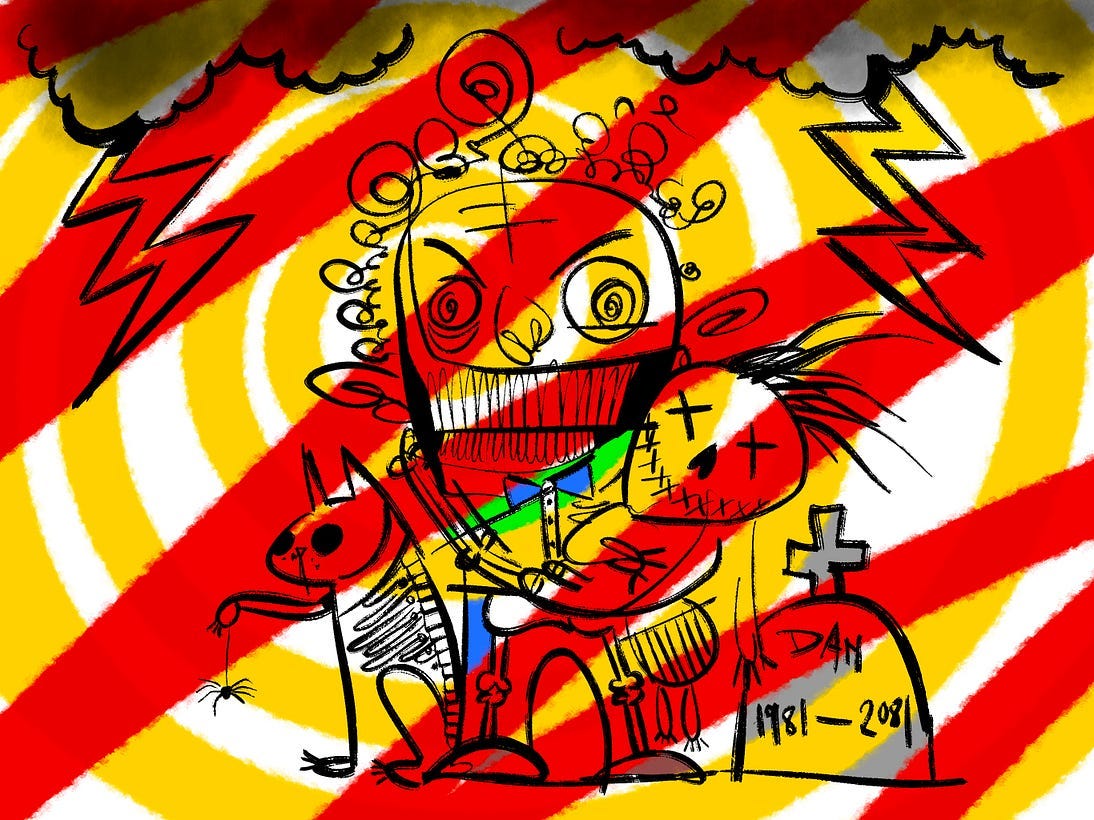
When I was very young, my grandfather told me something unforgettable about fire.
“Look.” He pointed at the flames through the stove’s window. “See the people dancing?”
Immediately, I did.
What had been a mighty wiggling of red and yellow shapes became people. And they weren’t wiggling. They were dancing. It was a jumpy dance. They leaped into the air, throwing their pointy heads and arms up and up, then they shrank so quickly it was like vanishing. But only so they could leap again.
I watched and watched. Fire was still fire, of course. And it was dancers. Two things at once. And what if it was also waves in a blood ocean and stabby snakes and blade fingers playing music for the eyes on dark instruments?
Grandfather had opened a door in fire. It could not be closed. I stepped through and began to learn there are doors in everything, and one house contains them all, connects them.
Everything’s connected.
It’s all one thing.
Dear Grandfather Edgar Joseph Babin, thank you for my first metaphor.
Grandfather Edgar gave other gifts, too. Up at the family camp, he built a lakeside swing for the grandchildren. The seat wasn’t a mere board; it was more like a hanging highchair, a wooden cage. You climbed in, or, if you were a baby, someone planted you in the cage, then that same someone pushed you flying out over the lake.
Another gift was fishing. He took my brother and me out in the boat and taught us how. He was a serious fisherman, which meant he would not be subject to the whims of childish bladders. If we had to pee, and of course we did — we were basically all pee — it didn’t matter; he refused to take us back to the camp.
But he had a solution: “Just pee over the side.”
Joe and I passed some telepathy back and forth: We can do that?
“Can we DO that?” Joe asked Grandfather.
“Yup.”
And we did.
“Pee on the fishes’ heads,” he said.
We thought this was hilarious. We had already been told by Mom and mostly Dad that we could pee outside. Now, we could pee from boats. We could target practice using fish.
I guess this means we are men? I telepathed.
Yes, said Joe.
What other gifts did Edgar give?
I like to believe he gave his best genes, the ones responsible for his brilliance.
Brilliant how? Let me count the ways:
One
He was a potato broker in Northern Maine. I know what potatoes are. They’re something halfway between apples and rocks. But what’s a broker? Before I look it up, let’s pretend it’s what I hope it is:
You arrive at someone’s house on your motorcycle. They lead you to a shed out back, maybe a dead car, or an out-to-pasture piano snarling in the yard, and they say, “Can you break that?”
“Consider it broken.”
As they watch you swing your hammer, they think, Damn, what a broker.
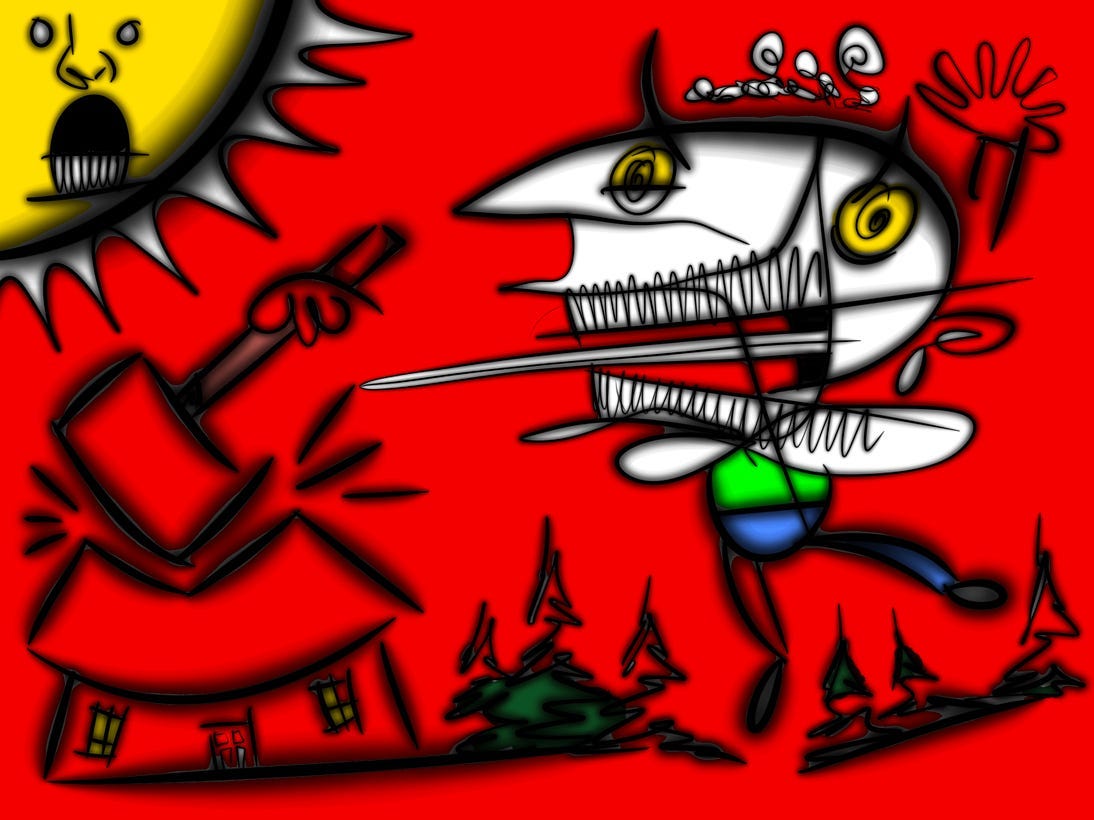
by author
I just looked it up, and sadly, with real brokering, you need more than muscles and a war hammer.
AI says, brokers do the following:
manage sales
negotiate prices
coordinate logistics (like transportation and packaging)
and ensure consistent supply, often acting as an “orchestra conductor” for the supply chain
See? To succeed at brokering, you need to be brilliant, and Edgar succeeded, putting food on the table of a big family (seven daughters), and having enough money to own a house in town and a camp on the lake.
Two
He was a carpenter. He built that camp. I call it a camp, but it was technically as big as a house. He built it from tip to tail, including a wooden chandelier, some of the furniture, and a second floor made of two lofts, one on either side and connected by a sky bridge.
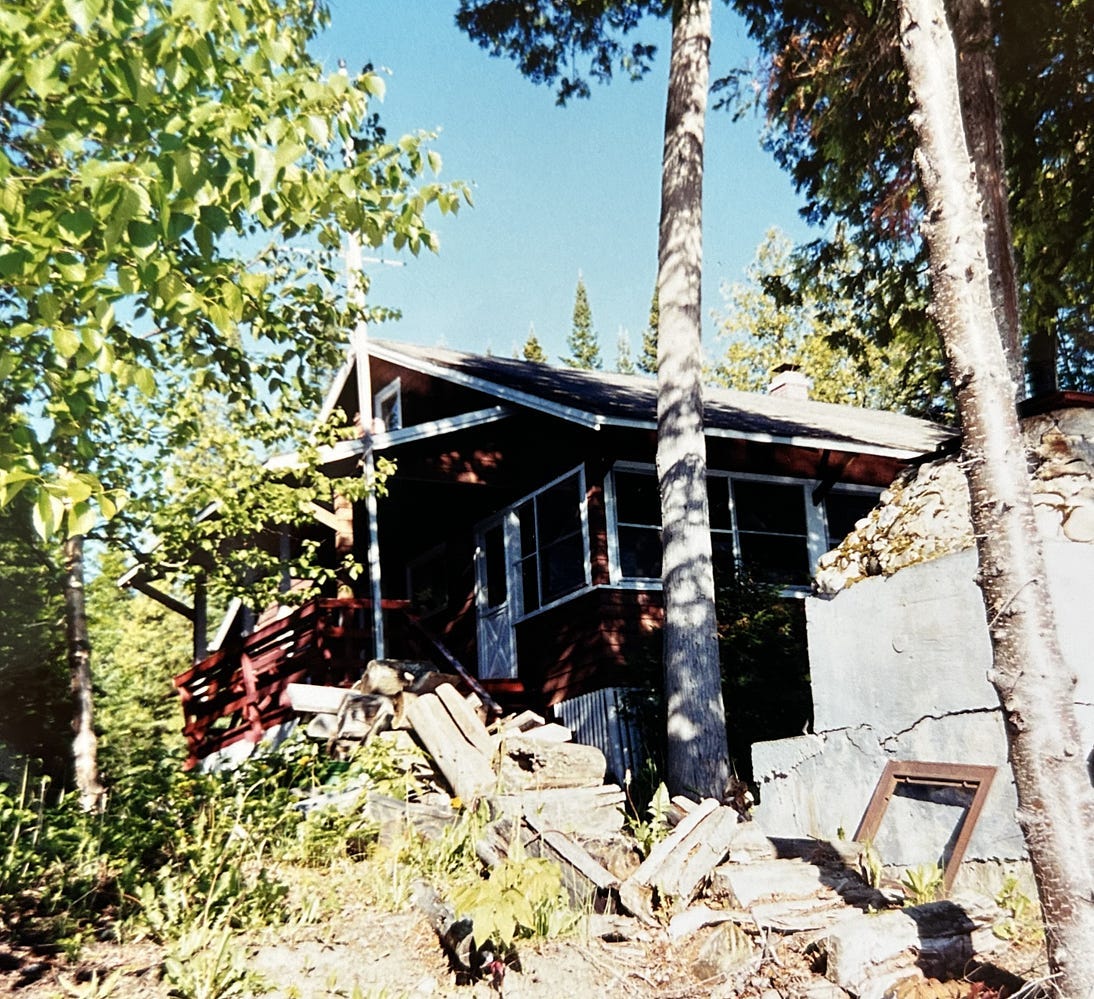
by Grandfather
Three
Edgar invented a form of radar for the military. I have no idea what it was called or how he did that.
But look at the intensity in those eyes.
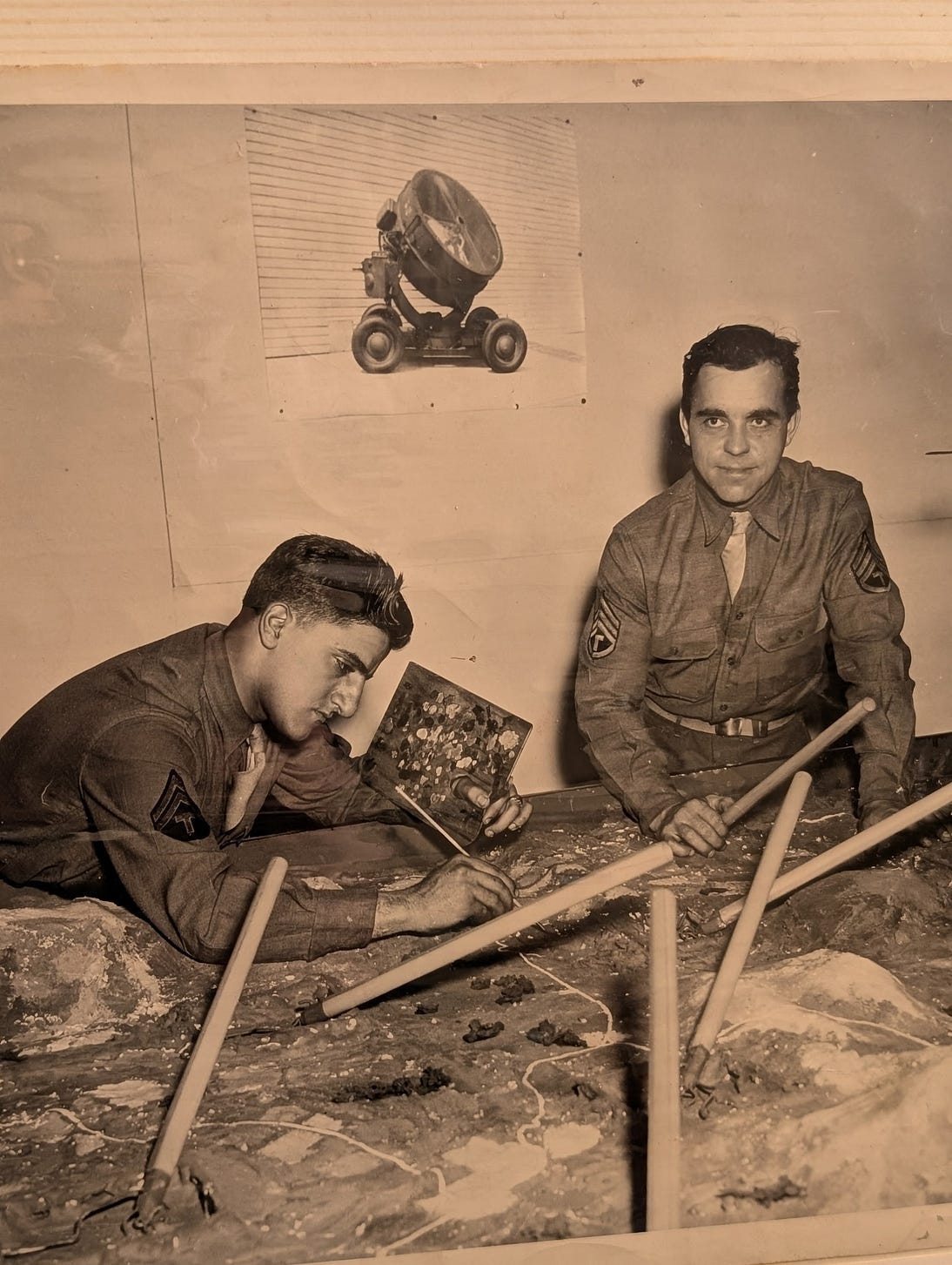
Grandfather on the right
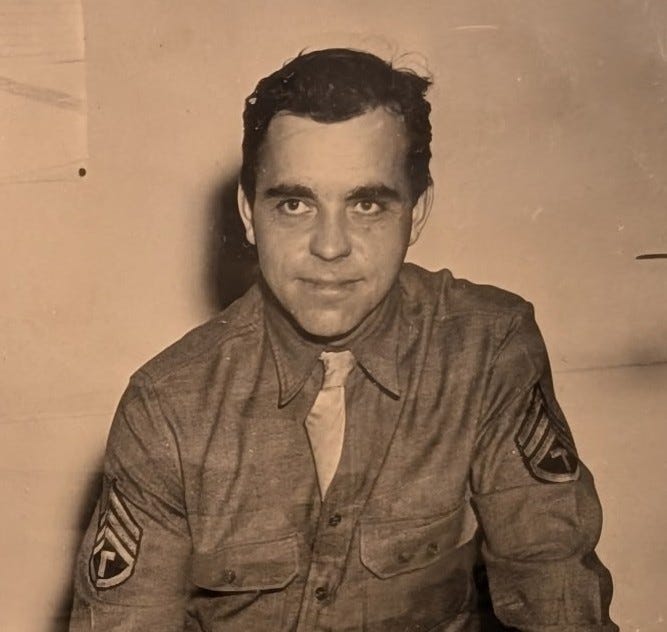
Heavens, that look.
Of course he invented radar for the military. He would have invented the military if we didn’t already have one.
I like to believe Grandfather Edgar took the genes that made him brilliant and passed them on to me.
But there’s something in my mind that came from the country of Who Knows Where?
That something is a dark side.
Always, always, I’ve loved the grotesque, the monstrous, and the horrifying. Creatures from these categories strike me with awe, the feeling I get from beauty. But this is off-beauty. The beauty hiding behind light. Beauty at midnight.
I love dark art, the paintings and/or drawings of Stephen Gammell, Ralph Steadman, Edward Gorey, Leonard Baskin, Hieronymus Bosch, H.R. Giger, and Zdzisław Beksiński.
Here’s a taste…
Gammell, Giger, and Beksiński:
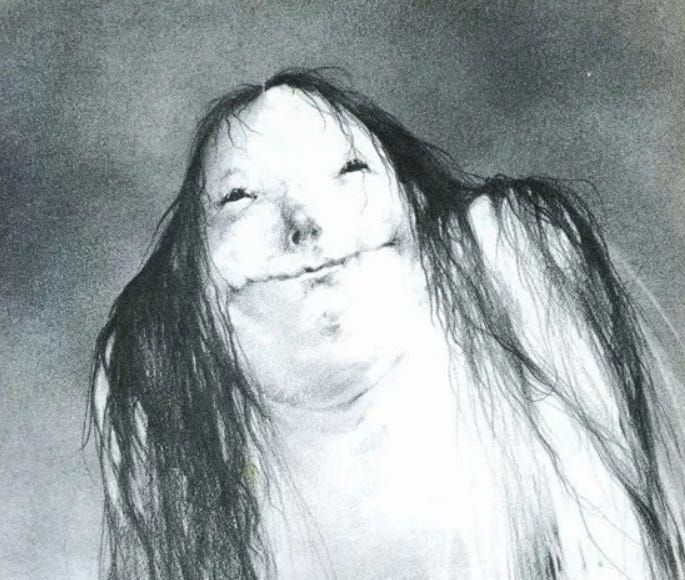
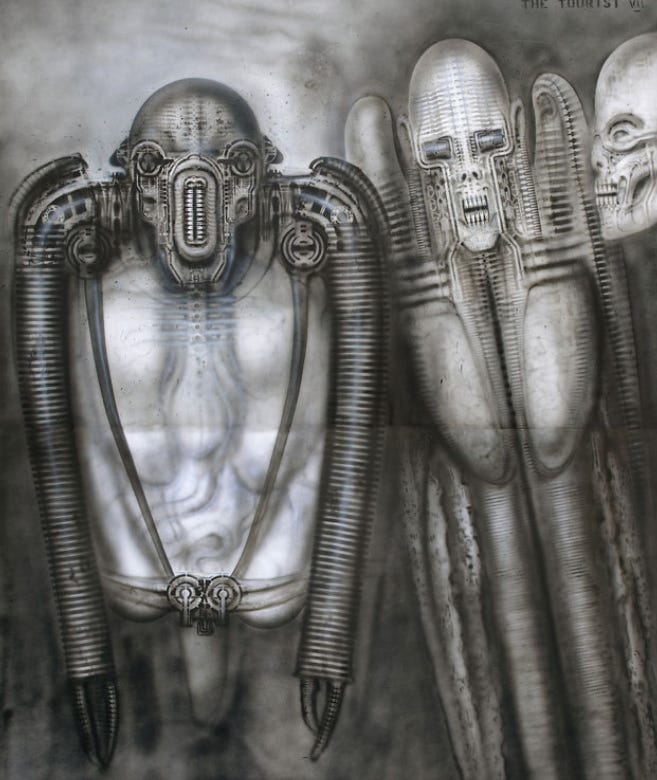
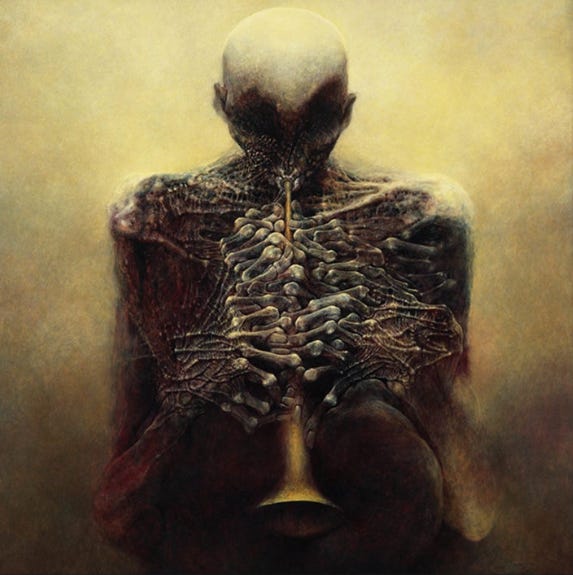
When I’m at my best, drawing-wise, I can whip up whiffs of the feelings created by these masters. My aromas are faint as phantosmia (tumor perfume), but they’re there.
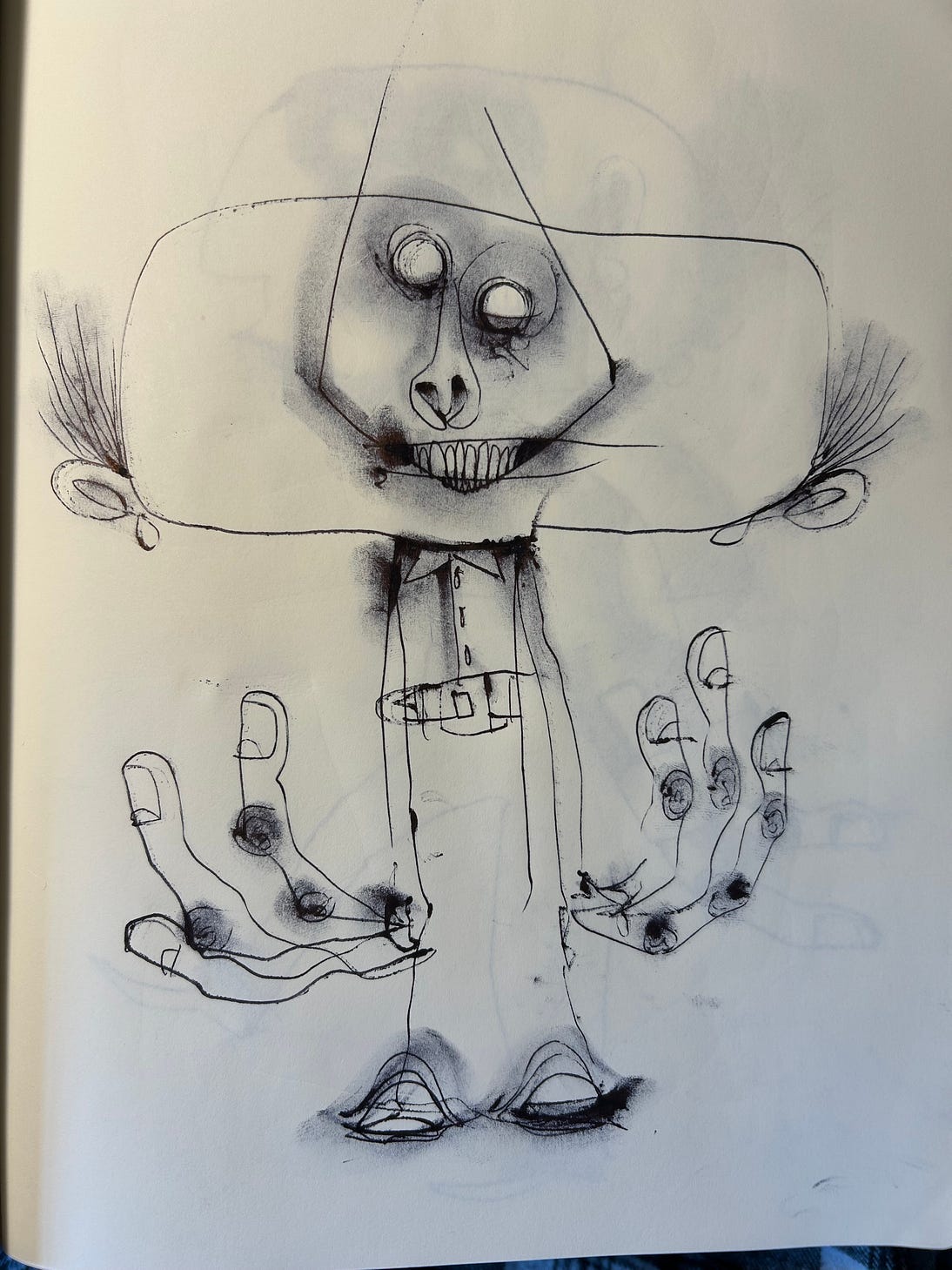
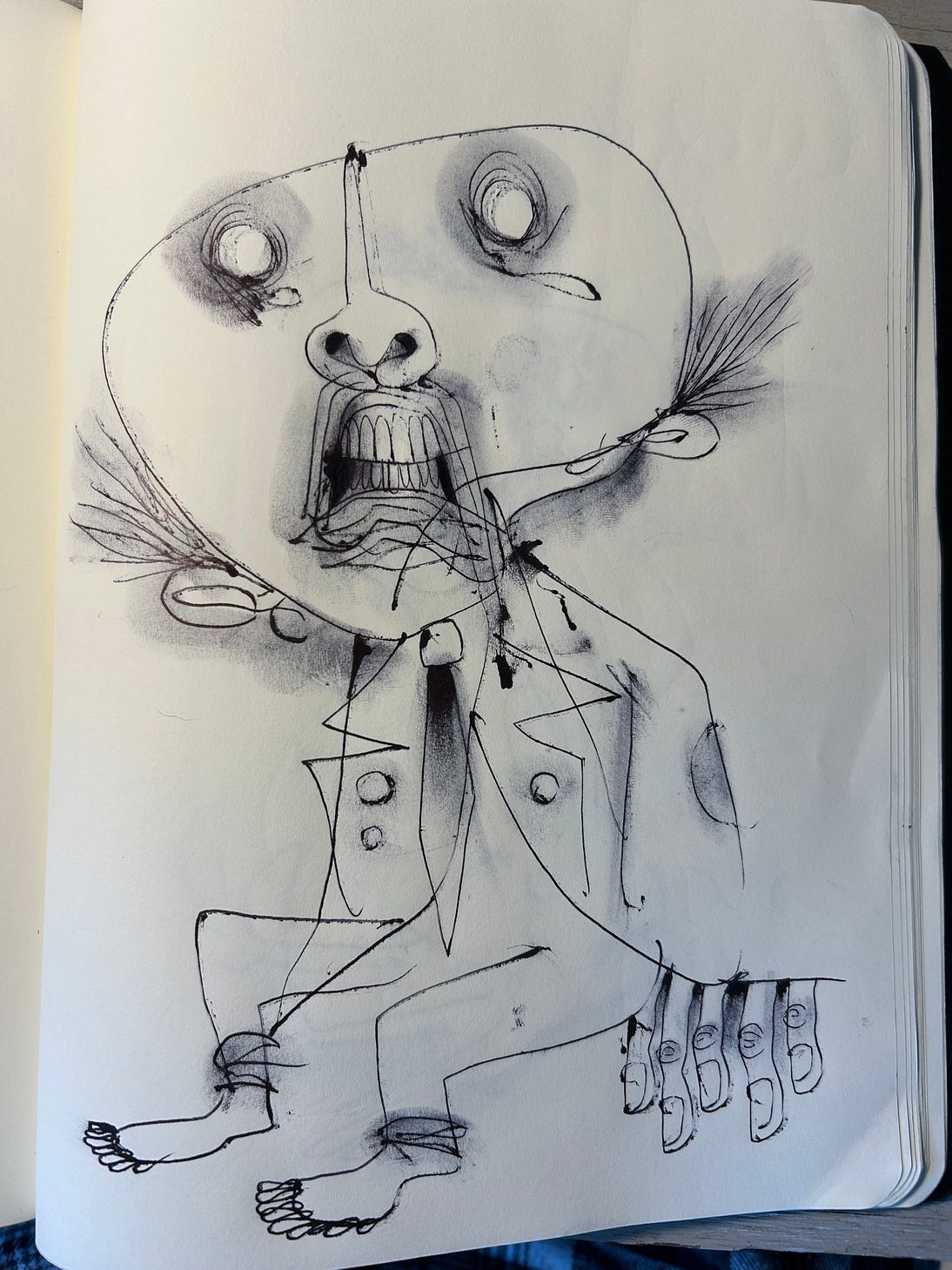
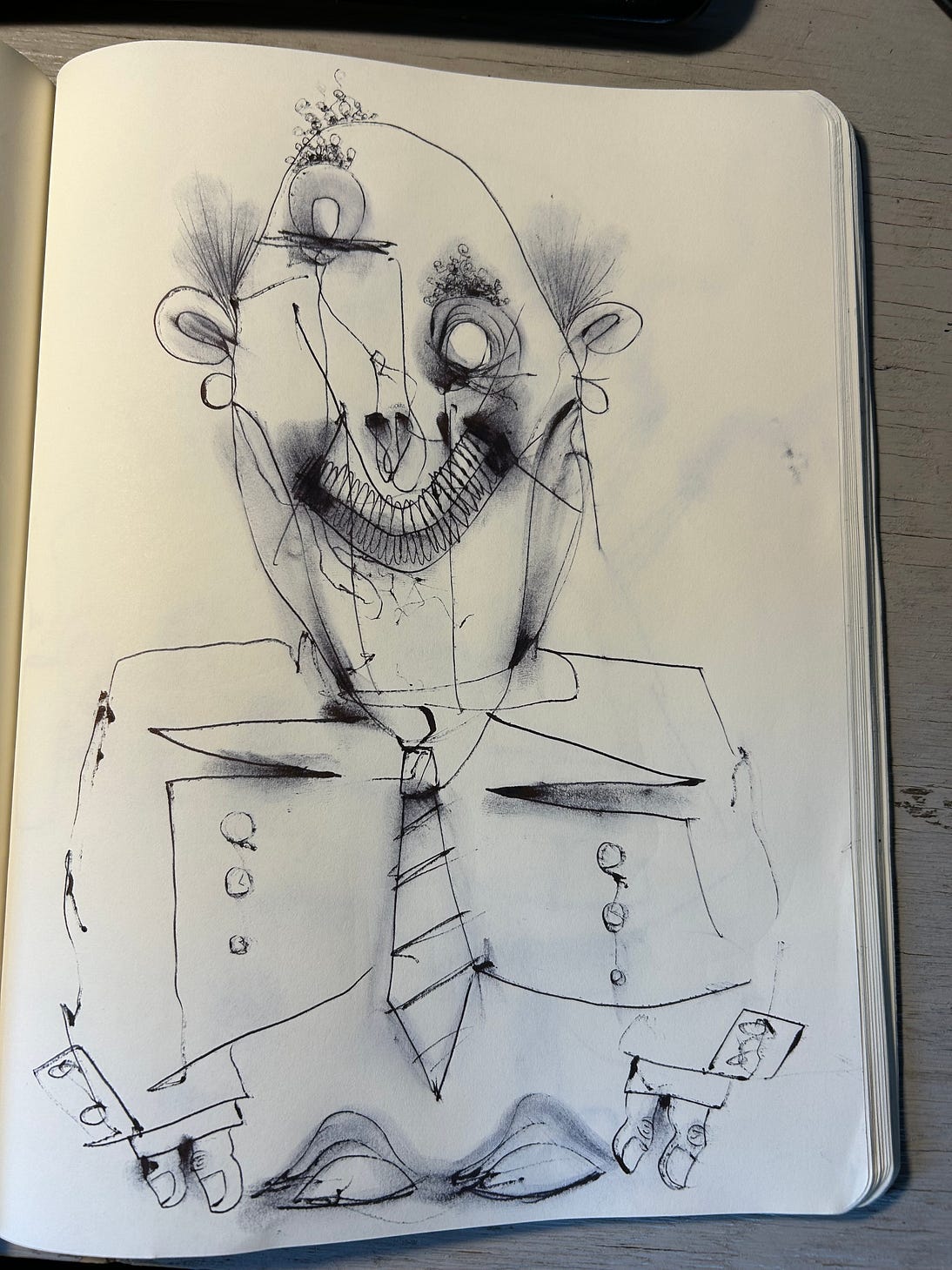
by author
Another feature of my dark side is the need to collect frightening toys and give them gargoyle jobs.
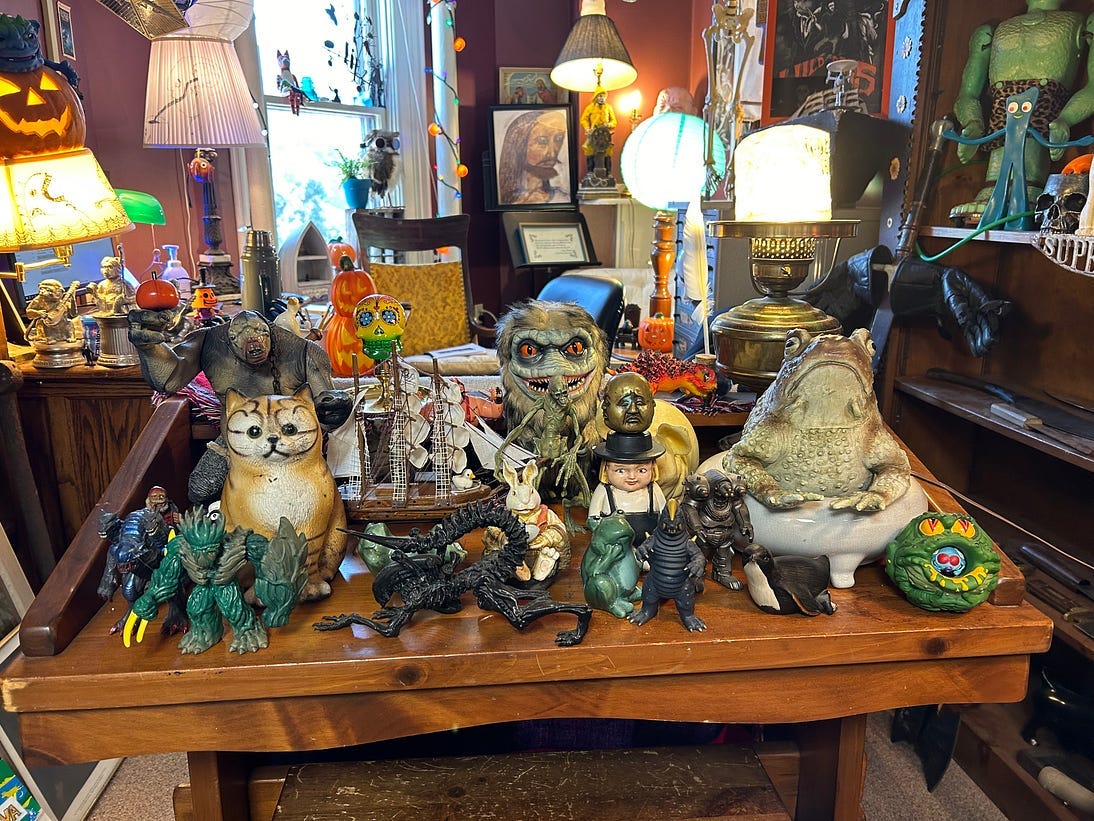
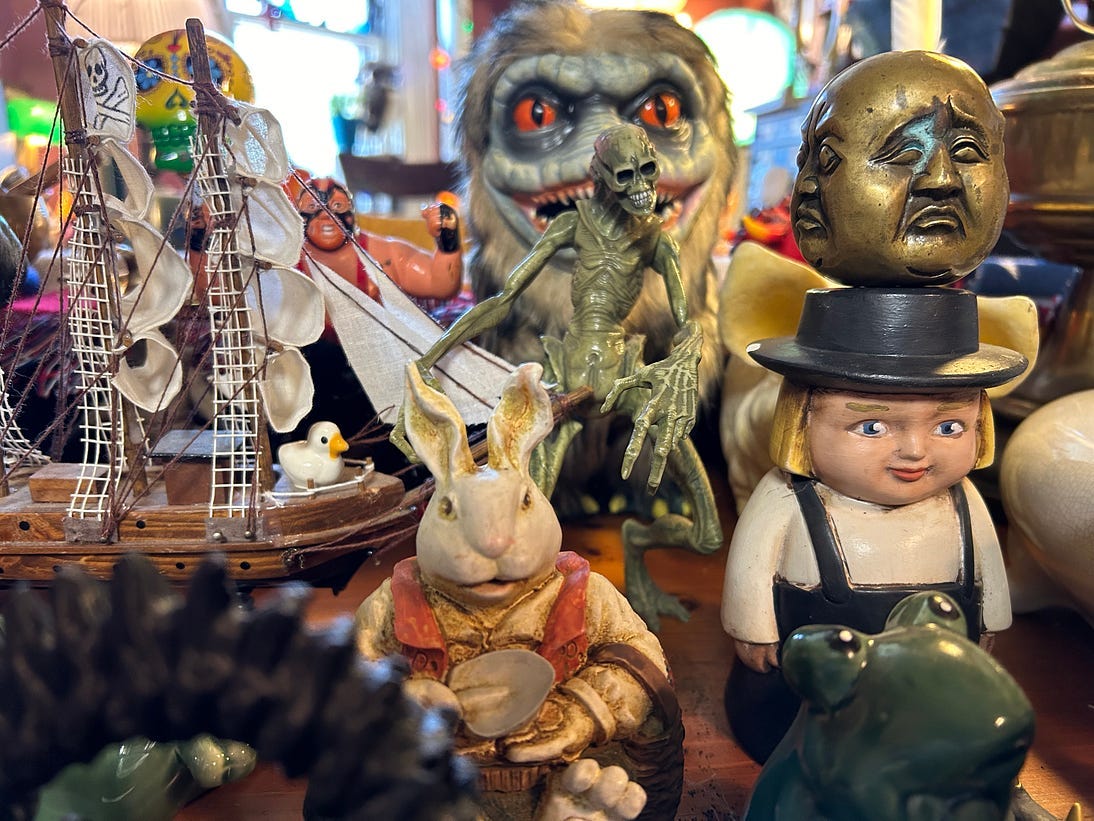
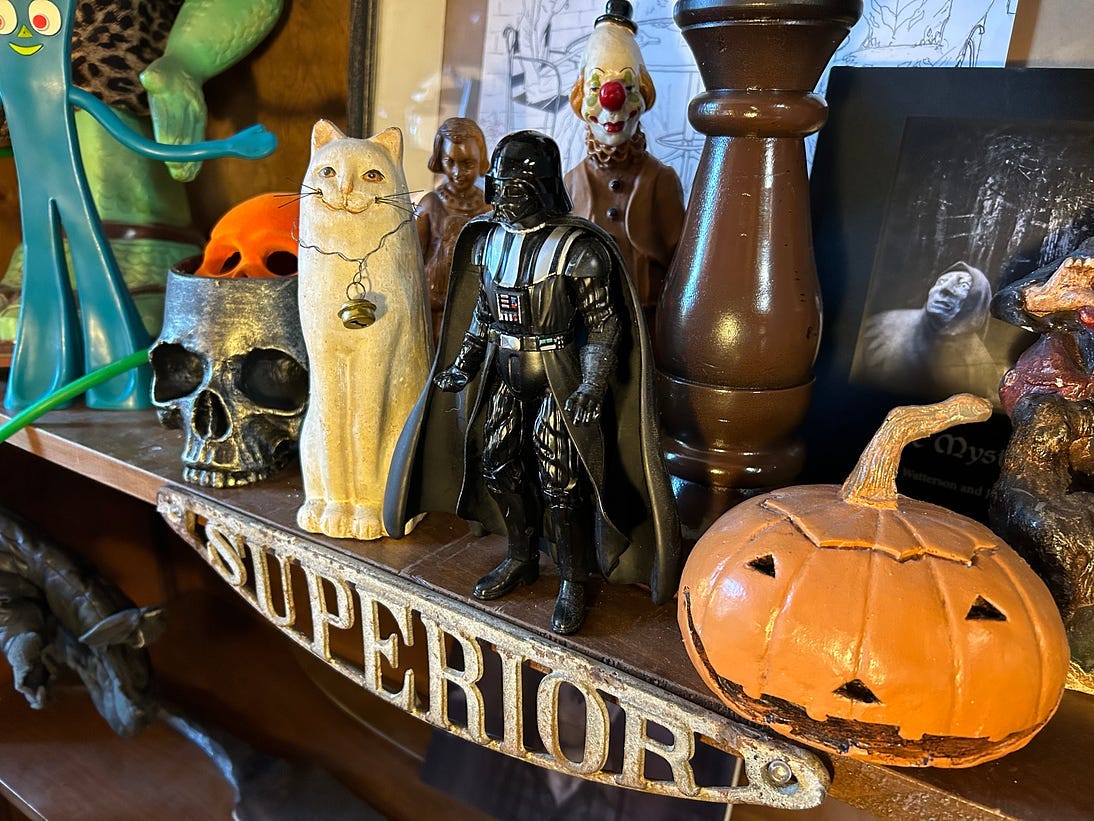
by author
How far back does the dark side go?
Let me show you:
Around the same time that Grandfather showed me the infinity in fire, Dad had me on his shoulders at Funtown, an amusement park in Saco, Maine.
We were in the haunted house.
One room was a jail cell. When we passed, pulses of light lit the cell, revealing a gigantic spider behind bars. He filled the room. He hissed and bobbed up and down. His eight eyes looked like a wall of eyes, all the eyes of all spiders collected in one place.
I didn’t cry out or go into horror-induced muscle spasms, breaking my father’s neck with my little legs. Nay, I reached for the bars. I grabbed them and held on tight.
I wanted, possibly needed (and would die without), a long look at the spider.
I had to see him. No blinking. I made use of every flash of canned lightning. I would not let go. I pressed my face between the bars — Here’s Johnny! — until Dad pried my fingers from their stranglehold. It was either that or stay there forever.
I wasn’t scared.
Wasn’t fascinated — that’s not a strong enough word.
I was meeting a dear friend, one I didn’t know I had. Straight out of Who Knows Where?
No, not from there.
He was from the heart country, a song from that place, music to my eyes, played by fingers sharper than fire and older than stars.
A chip off the old block of God.
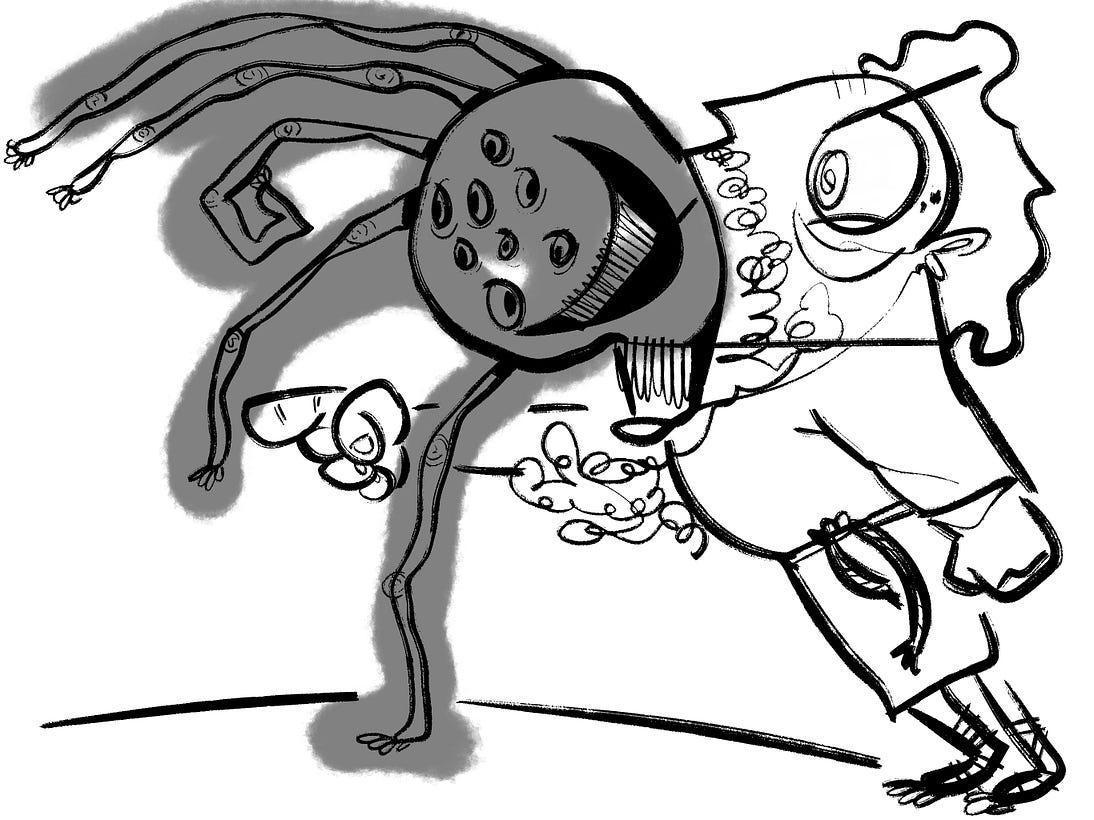
by author
I’ve wondered for years what caused my big spider moment. Was I so affected because here was a gigantic physical representation of a truth I’d only felt?
What truth?
Even as a recently-made human being, I suspected there was more to the world than bright spaces and happy faces. I felt there was something hiding behind trees, in swamps, and on the other side of smiles.
Something dangerous.
Smiles themselves are suspect. They are, after all, chock-full of cutting blades, and there’s a faceless worm in there that can shoot out, forming a child’s first middle finger. So scary to see.
Something dangerous, something true:
The world is sunlight, laughs, and happiness, but it’s also claws, fangs, and too many eyes.
It’s so good to know this truth because knowing makes you safer in the world. That means you get to live longer. And living, so often, is beautiful.
Is that the reason I’m drawn to the dark? Because monsters, devils, and haunted houses remind me that life is full of death, “So, watch your step. Survive,” and I’m so grateful for the reminder that I’ve come to love the messengers?
Maybe.
Or could it be a genetic thing?
We already talked about passing down good stuff. But what about this dark, bizarre stuff?
At first, my answer is, “Nope,” it’s not in the genes. I don’t know any ancestor who shared/shares my obsession with freaks, creatures, and uncanny valleys.
So, genes are out?
Not so fast.
What about transgenerational inheritance and/or epigenetics?
Since I can’t possibly explain these things well, I’ll explain them badly:
It seems you can pass experiences down at the genetic level.
Trauma, mostly.
It’s just that trauma packs a bigger punch than jollies.
Here’s how it works (again, badly):
Grandfather sees a monster. The shock wrinkles his genes, turns some into cutoffs, bleaches others, acid washes a pair or two.
So, Mom is born a little wrinkly, blotchy. She’s got some fraying. She’s distressed.
Therefore, I’m distressed a little.
There you go.
Now you ask, “Did Edgar Joseph Babin see a monster?” You could ask this about my parents and other grandparents, and the greats and great-greats, of course, but since we started with Edgar, let’s finish with him. For balance.
No, Edgar did not see a monster.
But he did see a horror once.
Back when he was a little boy, graffitiing the blank walls of his mind with first memories…
What Grandfather Saw
I don’t know why he was on the railroad tracks that day. Little, little children are supposed to be at home, not at the tracks. That’s just the rules.
And yet, that’s where he was.
I guess maybe he worked for the railroad company? After all, it was the 30s. The rural 30s. And so far out in the Maine woods that this was technically Canada.
In other words, what rules?
So, baby Edgar was out there felling trees, grading the land, and driving spikes when one of the older laborers, which could mean eight years old or eighty, said, “Hey kid, come look at this.”
A big group of men stood around something beside the tracks.
Whatever it was, Edgar wondered if it had to do with the strange feeling he’d had ever since arriving that morning. It seemed everyone felt it. The men were jumpy and quiet. Even the birds were quiet. And there was a strange smell in the air.
I’d say it smelled like pennies, but I’m trying to get out of the habit. It won’t be long before people say, “What’s pennies?”
But for now, most of you know what I’m talking about:
Yeah, blood.
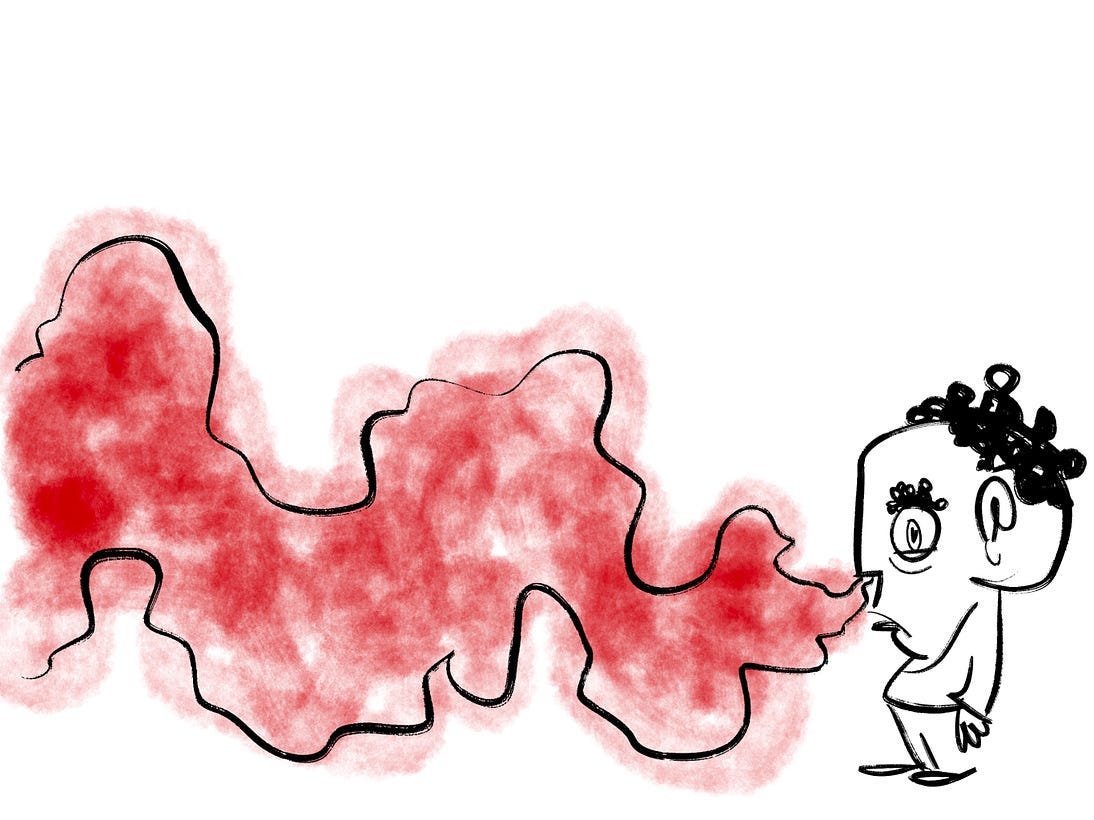
by author
Anyway, Edgar put down his hammer, spikes, ties, and rails, and walked over to see what the man meant by “look at this.”
The circle of workers opened like a shy clam, allowing Edgar through, and when he got through, he saw what they were looking at…
A basket sitting on the ground.
It had a red rag lying over the top of it, a makeshift lid.
The man who’d called Edgar over said, “Ready?”
“Yes,” said Edgar, saying so because he had no idea what was in that basket. If he had known, I bet he would have said, “Absolutely not,” and possibly “Never.”
The man pulled the rag away.
He didn’t rip it away like you and I thought he would. He removed it slowly, wringing as much drama from the rag as he could.
Gradually, Edgar saw what was hiding in the basket.
He saw brown stringy stuff. That was on one side of the thing.
On another side, he saw a disc of lumpy flesh. A mushroom.
Another mushroom.
On the side opposite the strings, there was a trunk like a tree trunk.
It all came into focus.
The stringy stuff was hair. The mushrooms were ears. The trunk was a neck.
Worst of all, there was more.
A face.
Complete with eyes, a nose, and a mouth looking like no mouth Edgar had ever seen. He’d never seen a mouth cut out of the midst of horror and agony.
Correct, a severed head.
Edgar stared down into the dead man’s face. The eyes were open and shining in the sun. A nose not breathing. A mouth bent in what looked like tremendous effort, as if the teeth had been clinging to the last breath, but it slipped out all the same.
“What do you think of that?” said the man, likely the Devil.
I don’t know what Edgar thought or said. What would you think or say?
What would you do?
Here’s what I’d do: I would never ever forget that head in the basket. I wouldn’t forget the red rag either. The silent circle of men. The smell. The sun shining on the open eyes.
Those sensory meteorites would hit my brain with a momentum that would sink them to the genes and bend some, singe others, and warp many, so many that some would go to a child or grandchild of mine.
A kid who just might be born with an odd curiosity he loves.
A taste for the dark.
An odd aroma in the head creating a certainty that there’s more to the world than what is easily seen and known.
The baby begins to believe there is a veil.
It hides sobering truths.
That veil comes in many forms. It can be a lie, ignorance, a railroad rag, or too much beauty all in a row, a fence as tight as a stone wall, and hiding something just like teeth hide their worms.
But now and then, something pulls the veil aside.
The darkness growing thick in old houses can do it. Lightning can, too. And spiders. The dead. Anything grotesque, monstrous, and horrifying.
Again, I can only say maybe: Maybe my dark side comes (in part) from Grandfather Edgar.
But when your maybes are equal, you get to pick.
And so, Grandfather, I give you my thanks:
Thank you for the metaphor.
Thank you for flight and the freedom to pee all over nature.
Thank you for the smarts.
And for the art of spotting heads in baskets, spotting truths that are helpful to me when I step out the door into the many-eyed, very toothy world, so helpful when it comes to survival.
And by that, I mean more than life.
I mean living.
How beautiful are the feet of those who bring the truth!
Clawed feet, ectoplasmic feet, eight feet…
I have to call these messengers what they are:
Yes, beautiful.
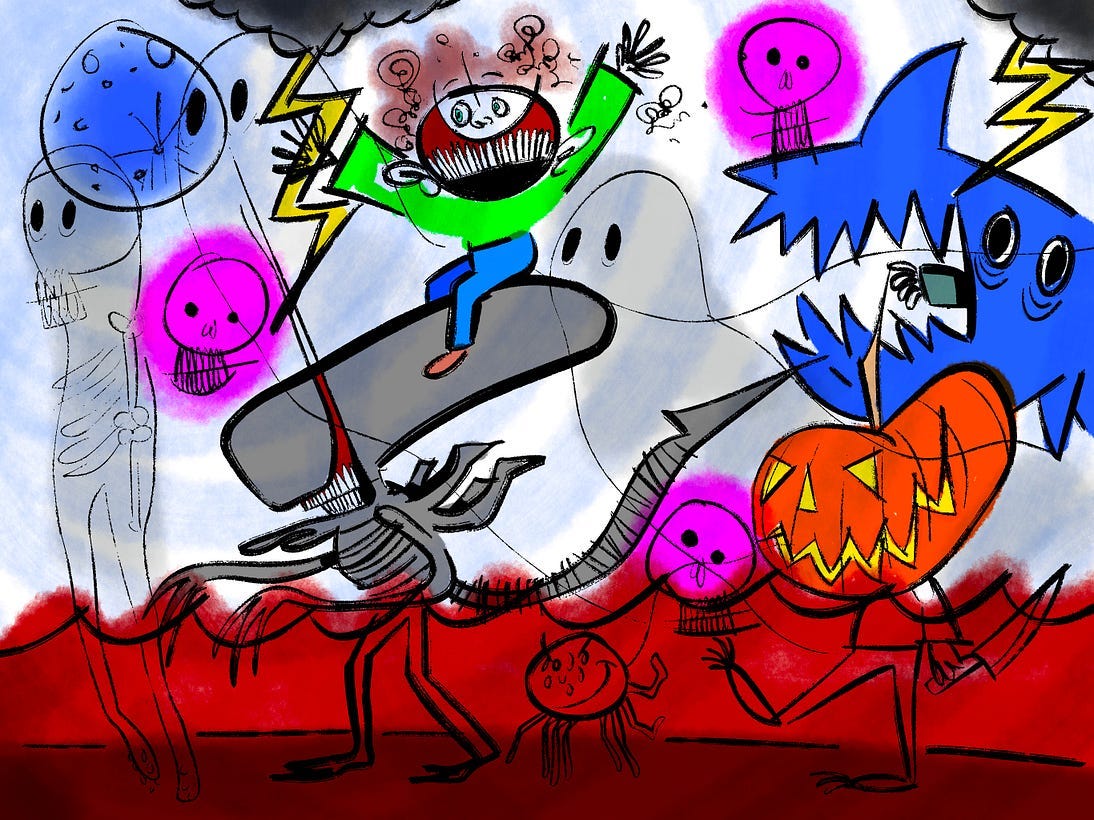
by author
The Beksiński piece is especially captivating. Really great stuff to pull from.