

Teaching Time With Violence
A lesson you don’t forget

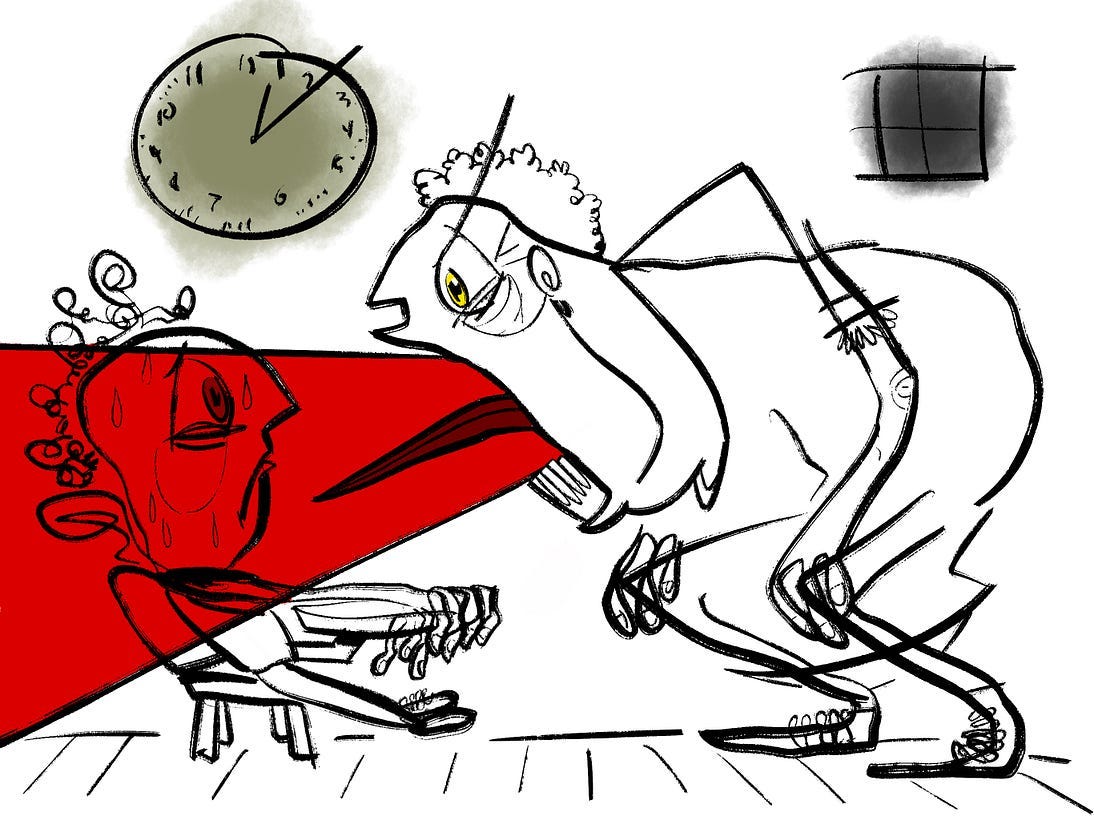
Second Grade
Mrs. Varney was furious.
At me.
Of all people.
“What TIME is it?” she said, again, pointing at the analog clock. I didn’t answer. Not on principle. I didn’t know enough then to take a stand against clocks and time.
Now, though, I’m against both. I’ve lived long enough to know that one kills you while the other won’t shut up about it.
But then, I didn’t answer because I couldn’t answer. There was just too much math involved, too much pressure.
Which equals performance lock.
She pointed again, again, again —
“What’s the time, Dan?! The time?! The TIME?!”
Even if I wasn’t destroyed by math and pressure, a boy can’t tell time through tears.
I was sad, scared, and devastated.
But I wasn’t angry.
I could never get angry at teachers back then. Now, I’m borderline murderous, but in the old days, it’s like I didn’t know you could be angry at teachers, could hate them, could pray daily for them to contract rabies and swallow their tongues. I certainly suffered under the oddments of their cruel and unpredictable personalities, but wanting them to pay for their crimes, wanting them to suffer the loss of continence, mobility, sight, offspring, and salvation, this never occurred to me.
Getting angry at a teacher would have been like getting mad at winter for my frozen ears and fingers, mad at my bed for being the extremely loose lid over hell.
Winter, hell, and teachers were things that just were, as unquestionable as mountains. Stub your toe on a mountain, you can only be mad at yourself.
Don’t get me wrong, I’m just like you: I was a child full of wrath, rage, indignation, acerbity, and no thesaurus skills to help me vent it all down different yet similar avenues.
I was Sir Wrath Bastard Magnificent, venting on my family and myself, and I could do so because these people belonged to me.
If you own Stub-Toe Mountain, anger’s back on the table. Get as mad at that mountain as you like.
But Mrs. Varney belonged to the Devil. She was his to hate. Mine to endure.
So, now you know why I wasn’t mad at Ol’ Varney.
But why was she so mad at me?
In part, probably because you’re supposed to learn analog clock reading way better and faster than I was learning it.
Her anger also had to do with her denial of some pretty important psychology:
Some people
have trouble
answering questions
when you shout at them in public and point with the velocity of crime-of-passion stabbings.
When grilled, one can panic.
It still happens to me.
I’ll be watching subtitled shows. During scenes of speedy talking, I’ll feel panic rising —
Hurry, Dan, the
words
are VANISHING fast!
Can I read
every
other
word — NO, read them all or it doesn’t
count! Hurry UP!
You’re running
out of time, time,
TIME!
!!
It gets so bad I go word blind. My brain blood drains from the neocortex, the mathy patch, and travels to Monkey-Lizard Town, a place that knows only screaming and blunt-force escapism.
So, you’d think Monkey Town would have suggested that I scream at Mrs. Varney while clubbing and puncturing her to death with books and pencils before running away, but again, I couldn’t; she wasn’t family.
All the miserable animal Dan could do was murmur, “Umm…” and “Uhh…”
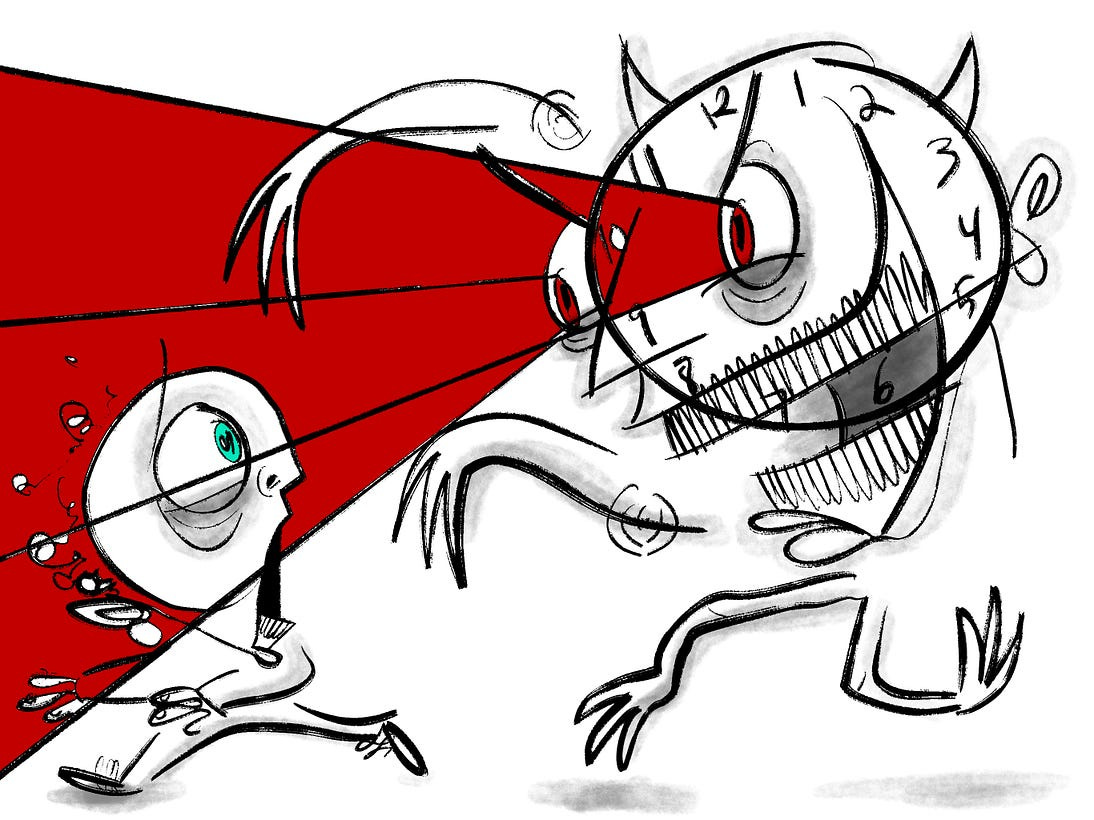
by author
I can still see Mrs. Varney marching up the aisle between desks, coming closer and closer, as if that would help. Did she think she was fingers pinching their way up the toothpaste tube? Did she see me as a boil festering with correct answers, needing a sort of midwife to stomp on either edge, Pogo Ball style, to make me erupt with my answers?
When I inspect the memory of her me-ward march, it’s weird. I see twisting, tipping movements, a walk in a funhouse mirror. Like the floor was rocking this way and that, forcing her to swing her head for balance.
A massive head. Her skull was a bone boulder wrapped in red meat, and even bigger with the helmet hairstyle of no-nonsense adulthood. And bigger still: puffy with fury, a morbidly-globular tick for a head,
suckled on hogs of war.
She twist-tipped this way and that, never falling over like someone should when the ship of the world has its deck violently rocking, never slowing or stopping to steady herself, but coming steadily on, advancing to get her answer out of the umm-uhh outlaw, the lockjaw artist.
This is what memory does, by the way: It takes something true and soaks it in the emotions of the time, flavoring and swelling what happened with how it all felt. The truth bends, bloats, and mutates, turning into something true only for the person who built the memory, but so incredibly true for them it’s gospel.
Qualifier:
Some folks do this more than others.
I don’t know why, which means the answer lies in the realm of the unknown.
While in this realm, it’s easy to flatter oneself, so I will: Those who warp memory more than others have more powerful emotions and imaginations.
Truth can stand the fires of those only mildly moved by life and lacking in imagination, but throw an iron slab of truth into the furnace of one who lives and dies by feels and dreams, and that metal is dust and clay in the hands of crafty gods.
Outsiders wouldn’t even remember that second grade day. If they did remember, it would be amazing, because nothing interesting was happening for them, just a little Dan sitting there and a teacher-sized teacher asking him questions, a little loudly, maybe, but not loud enough to start up the memory factory.
Anyway, “Time!” she said/shouted.
“What’s the TIME?!”
Her arm made whip cracks in the dead air.
I wanted to answer. I really did. That or die, whatever would make it all stop.
But I couldn’t answer or die. I really couldn’t.
Hindsight says I wasn’t destined to die then, and I couldn’t answer because of all the reasons I told you.
Those reasons had transformed the clock into a tear-smeary mess of gruesome markings scratched into existence by an incarcerated madman. Marks like that tell us nothing about time. They say only “Indeed, he is mad.”
And Mrs. Varney was mad, as you know, for the reasons I explained:
I wasn’t answering,
and she had a dark-ages understanding of psychology, which blames all problematic behavior on body juice colors, and since it’s hard to get mad at juice, you transfer your anger to the bearer of the juice,
the Dan,
but all this can be stated more simply:
A misunderstanding.
She misunderstood me; she thought I could answer.
I couldn’t.
And because she thought I could, my failure to obey read as obstinance. Badness. Here was a boy pretending to be a numbskull.
I wasn’t pretending.
My skull was numb. Numbified to the point of no return.
What should have prepared me for the clock misunderstanding was a previous time Mrs. Varney had misunderstood me.
During a storytelling portion of the class, I made a little book, fully illustrated. I remember next to nothing about it, but I do remember the final page, the final drawing, which was the culmination of the author’s powers.
I’d drawn a picture of men marching over a hill. The hill went from one side of the page to the other, a big frown. On the right side, so close to where the hill met the page’s edge, there walked a very small man, heading west (left). On the left side, I’d drawn a very tall man walking (about to step off the page). Between the bookend men were other guys; these worthies bridged the tall and the small by becoming taller and taller until the penultimate guy was just short of Mr. Tallest.
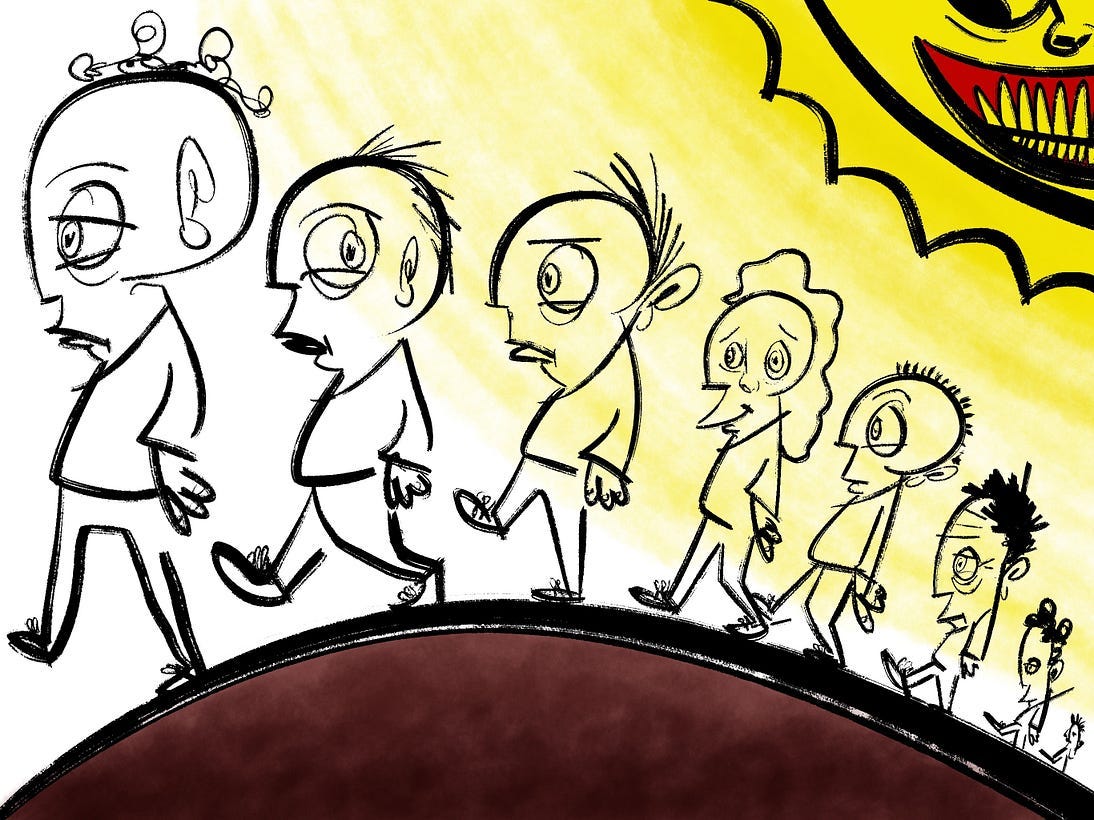
by author
I was so proud of my drawing, I carried it to the front, the big desk.
The Varney.
She took a look, and I remember:
She loved it.
She smiled. She sat back in her chair. Slayed. The little boom of it shook her unshakeable hair. Her eyes were bright with live, laugh, and love for me.
She said something big like, “Wow.” She looked at the drawing longer than teachers look at anything, which is not their fault — they have to have eyes for everything and everywhere to put down mutinies, fomentings, and insurrections.
But Varney looked and looked, smiled and smiled.
I was on the verge of hearing my calling:
From now on, and for the rest of forever, I shall draw hills that span pages.
I shall draw men walking from the right side of those hills to the left.
Those men will be taller and taller until the last man is the tallest.
The world, in love with me for this, will give me even more paper, all paper, forcing me to continue the hill and the men until one of them is so tall that I’lll be drawing God himself.
In the other direction, the men will be smaller and smaller until they are atoms, and smaller: grains of sand marching on beaches in the quantum realm, then flea-men on the backs of these men, and even fleas on these.
Upon seeing this infinity in both directions, all adults and the rest will rise up and call me blessèd.
Which is the best answer ever when it comes to the question, “What do you want to be when you grow up?”
Blessèd.
What else do I want to be?
Everything to everyone.
With enough paper and praises, I will see it done.
Isn’t it terrifying how one compliment can change the shape of someone’s future?
That’s what happened with me and writing, by the way.
When I took my first creativing writing class in college (a random-chance elective), a single teacher murmured in my direction, “Not bad.” Next, I sold my soul to the Devil for the chops to catch God’s loving eye.
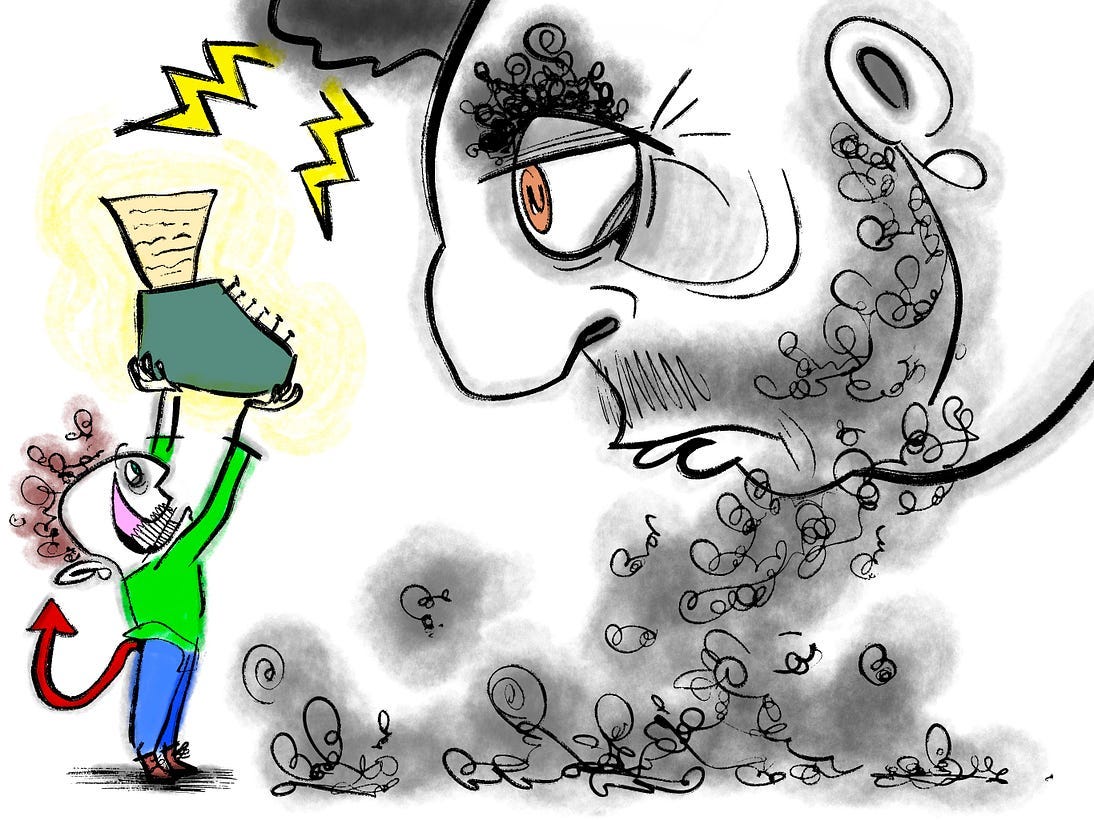
by author
As Varney smiled and stared at the hill men walking, my hands itched and twitched to get back to my desk, pencils, and pages, back to the work for which I was born, but I would never move, not so long as her love light was shining, thawing me out.
But then Varney said a thing:
“You know perspective.”
My smile remained, but the foundations fell, making the smile sag a little, the ground above a collapsed coffin.
My eyes muddied with confusion.
If I knew perspective, I knew it without knowing it, because the word “perspective” meant nothing to me.
Seeing this, Mrs. Varney said, “See?” and pointed at the big man. “He’s physically closer to us.” Then she traced her finger along Frown Hill from man to man back to Mr. Smallest. “They’re farther and farther away, so they’re smaller. That’s called perspective. Close things seem bigger to us when we look at them, and faraway things seem smaller. You know perspective.”
I didn’t.
I mean, I did. I knew that when I was closer to my big brother with the wiffle bat I was trying to beat him to death with, he was bigger, big enough to reach with the bat and to murder. When he was far from me, however, he was too small to reach, so I had to get closer, which grew him big enough to kill.
But that’s not what I’d drawn.
I didn’t know how to tell Mrs. Varney this wasn’t a perspective drawing. At all. It was fantasy. It was a line of men marching, the front man being a giant, and the back man being a wonderful mini-man. If you faced the big man, you wouldn’t see the endless men standing behind him because he would block them. You wouldn’t know what hid behind him: men getting smaller and smaller until they’re so small they can infiltrate your body as a vapour and correct or encourage your autoimmune diseases, depending on how I feel about you.
And just as I didn’t know the word “perspective,” I didn’t know the words for telling a teacher she was wrong.
These are those words:
“To hell with perspective, Mrs. Varney, I want the impossible. I want giant men walking, I want small men microscopic.”
But, again, I didn’t have those words.
Or maybe I did; I just didn’t dare to use them, not while basking in the love-light of Mrs. Varney’s admiration. That rare glow. If I’d tried to tell her she was wrong, I would have lost the glow. Her smile and eye would have darkened, forcing her to say something devastating like, “Oh,” then she would have given the book back to me, roughly, a giving back that would have served as an order:
“Return to your seat. And stay there. Trouble me never again with empty fantasies.”
Her glow didn’t go, but it did dullify when she saw the sunkenness of my smile, that sign of confusion.
Go away. Stay away. Bother me no more.
I returned to my desk. I sat. Shut my little book, and that’s where the memory stops.
That’s where my career of drawing hills and freaks for glory stops.
What started up again was just more forgettable second-grade time to chew through. Once more, I was an earthworm impacted within a planet petrified to steel.
An earthworm who couldn’t say how long the imprisonment would last. He could say “forever,” but he couldn’t say it to the minute or second.
“What time is it?” said Varney.
I said, “Umm… uhh… ”
“Don’t ‘umm/uhh’ me. Tell me. Look at the clock and tell me the time. You KNOW this.”
No.
I didn’t.
Not in those conditions.
And again, friends and neighbors, she was furious. Because the boy who would draw a hill just to put something as dull and scientific as perspective on it is a boy who does know time. A boy who can tell it easily. A boy like that who says “Umm…” a lot is really saying, “To hell with you and your authority, Mrs. Varney. I recognize neither as significant. This is my vote of no confidence.”
But Mrs. Varney, I was never that boy.
And, Mrs. Varney, I’m not the man a boy like that would grow into. Today, even though my analog abilities are so much stronger, I still couldn’t give you the answer, not if you were here right now, lashing me with your arm and tongue, mystifying me with your Halloween walk.
I would resurrect and use again my old and ugly “umm…” and “uhh…”
My panic.
The big man I am now, 44 and more every day, would become the man I was yesterday and the day before and the day before that: 43, 42, 41, 40, younger and younger, smaller and smaller.
All the way back to nine.
To eight and a half.
To second grade.
With first grade breathing up my neck, that little dummy. And all the dummies before him, littler and littler men, back and back to the threshold of the womb and the kicking and swishing of the little guy inside.
A boy absolutely in the dark.
And still, I wouldn’t refuse you an answer out of obstinance. Still, I really would want to answer you.
Maybe you would call this perspective, Mrs. Varney, and I guess you’re right. This time.
It is about perspective.
I’m now far enough away from your violence to know you were just a person, like me. Under pressure. Having a rough go of it, because that’s what living is most of the time.
That’s what I know about time now.
And memory.
And the feeling of it.
The three together hold you, Mrs. Varney. You’re 36 years ago, that far back.
That small.
I’d like to say that from way out here, you don’t look so bad. You’re not really that loud, that mad.
But all I have is the fantasy of memory.
A memory that’s true to me in a way it can never be to you.
Maybe when you think about that day, if you think about it at all, if you’re even still alive, you think about the backwards children of that backwoods town, little idiots who couldn’t learn because they wouldn’t learn, and you sigh with wisdom’s pity. You remember your righteous indignation in the face of it all; this is your pride, you are noble, and the hills you marched and died on grew you into the biggest person you could be, one just trying to make this world a better place.
Who is right?
We won’t know until we step off the page into the place of no time whatsoever.
But now, in the fantasy of my past, I enjoy the right and authority to say to you something devastating:
“Oh.”
What time is it, Mrs. Varney?
Time to tuck you away again.
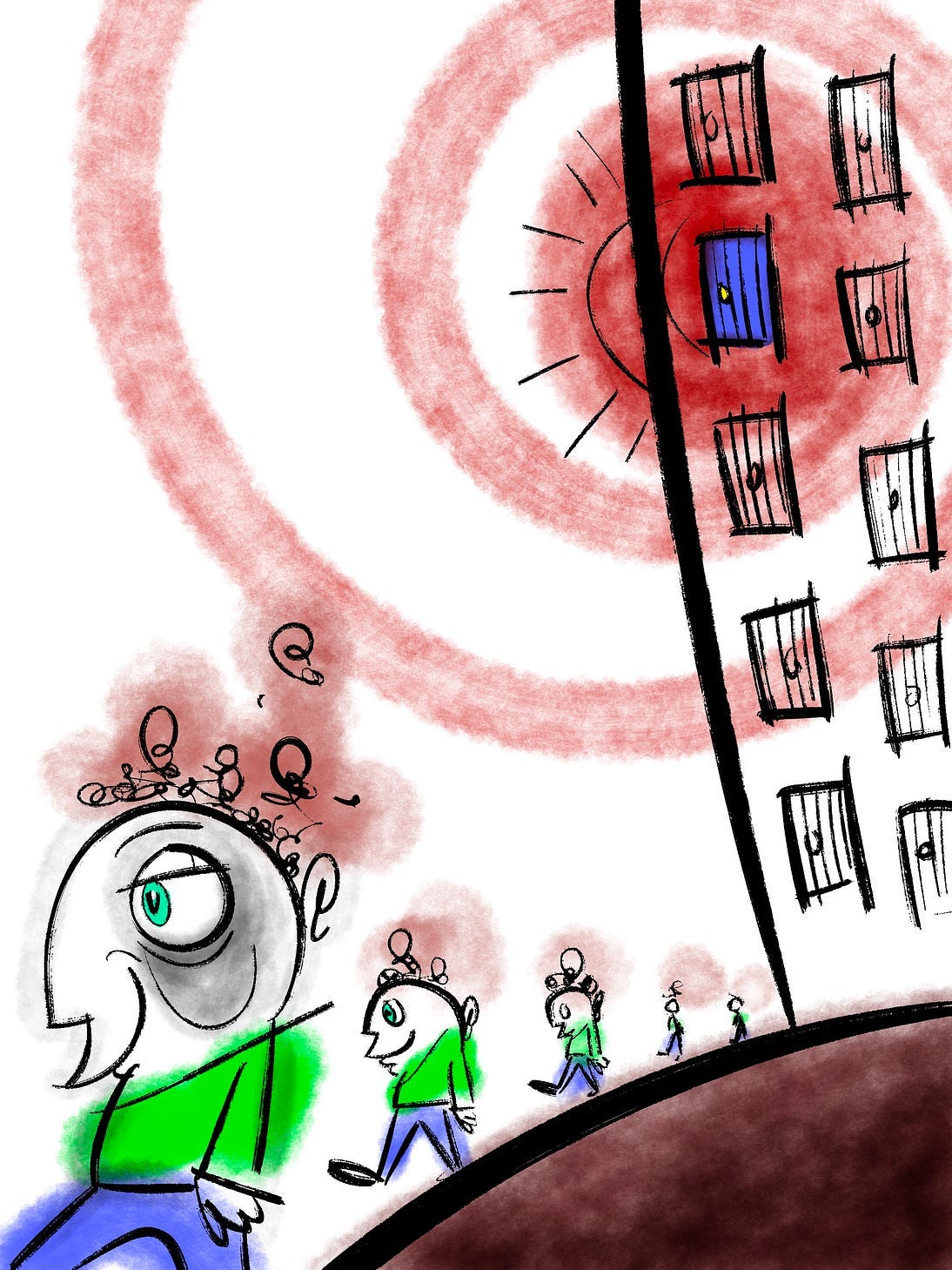
I’m closing the door of the little classroom hanging in the dark of decades ago. It’s a wee cupboard on the wide, tall wall of memory. Yea, I’m shutting the door again. Yell to your heart’s content.
I can barely hear you, but it sounds like Monkey Town in there.
I’m walking away for another little while, walking downhill into bigger and bigger revelations.
But I’ll return and return, of course, like clockwork. That’s memory for you.
I’ll come see you again, so I can tell you again,
the time.
by author
I've said it before...you are exceptionally creative. ~J