

I’ve Only Been Fast Enough Once
It won’t happen again

My friend’s little sister died when he was nine, which tells you how impossibly young she was.
Nine barely counts as being here. It’s so new most of its thoughts belong in a baby’s head. For example,
Nine believes the sun itself (the universe) dims when hidden behind clouds,
believes toilets flush into a great poop ocean in the center of the world,
believes God is cut from the same asshole cloth as Dad, though to be fair to Nine, the thought does explain a lot.
And memory basically showed up this morning in Nine’s brain. Just yesterday, that wrinkly gray ball of nonsense was rolling along like a hot stone through snow, nothing sticking. No consequences. New every morning. Today, Nine only knows enough to wish it was yesterday still, and it might not be wrong.
My friend was Jay Philbrick; we were both nine.
And again, Mary was even younger than that, though it’s hard to believe anything could be younger than nine.
First grade.
Mary was six years old when she died. It was Reye’s syndrome, a very rare condition that causes swelling in the liver and brain.
“very rare” is wonderful until the thing strikes your family. Then, what could be worse? A windfall from hell.
I have one memory of Mary. Just the one. We were talking on the school playground. I found it interesting/odd that we were talking, because she was much younger, so how dare she speak to me in public?
But she did. Boldly. Maybe she dared because I was Jay’s friend.
What did we talk about?
No idea.
But a storytelling teacher of mine once said, “I write to remember,” so that’s what I’m doing, hoping to write my way back to Mary’s words.
Fingers crossed.
What I do remember right now is Mary’s hair.
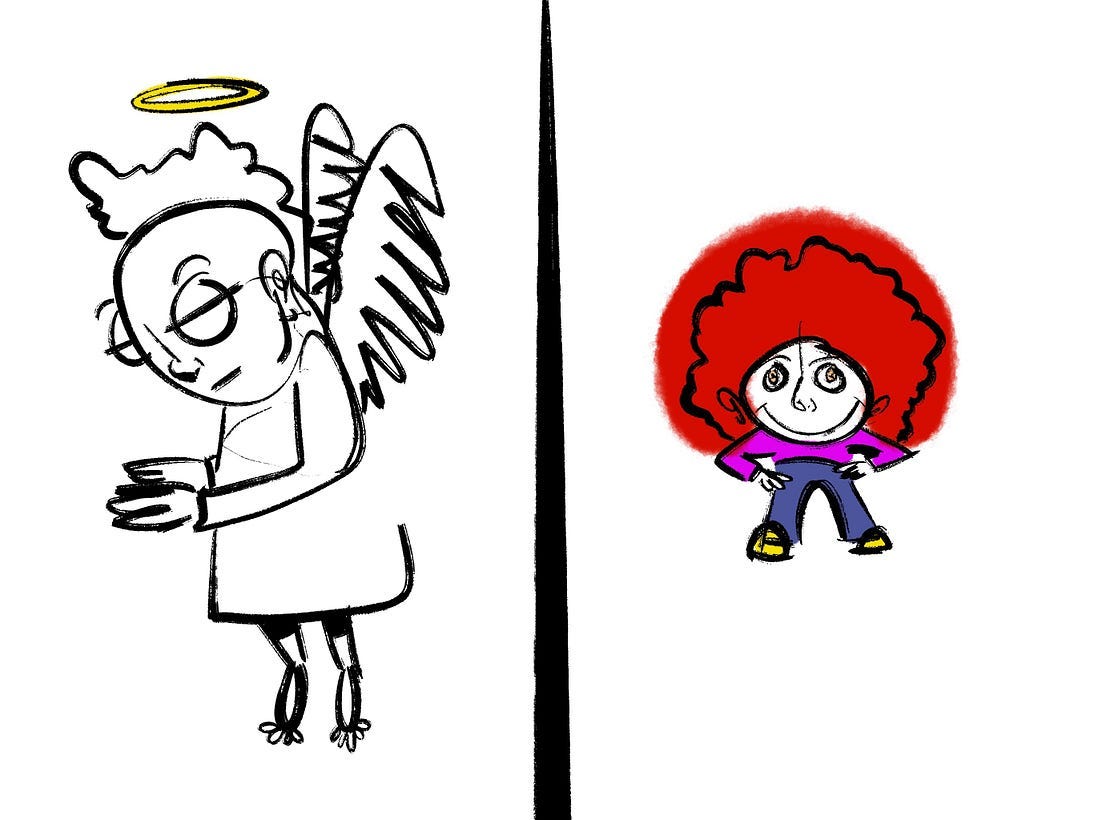
She had bright red hair that was large all around her little head, a halo. A medieval halo, not the skinny ring kind that hovers like toilet seats over saints and angels.
by author
Big red halo hair, big voice, big confidence.
Little Mary.
Six years old.
The Philbricks lived next to a cornfield. One day, Jay and I went into the corn to play a game I’d never played before.
Jay called it “Hey, Let’s Run Through The Corn.”
We did, and though I’d never done it before, I was soon awesome at the game.
All it requires is that you’re fast, wild, and want to stay longer.
Forever.
A man could live in the corn.
The only running I’d ever heard of that equaled mine in the cornfield was some running Dad did when he was young.
It happened on a winter’s night. The Church’s evening service ended, and he ran the snowy road home, two miles under the stars and moon.
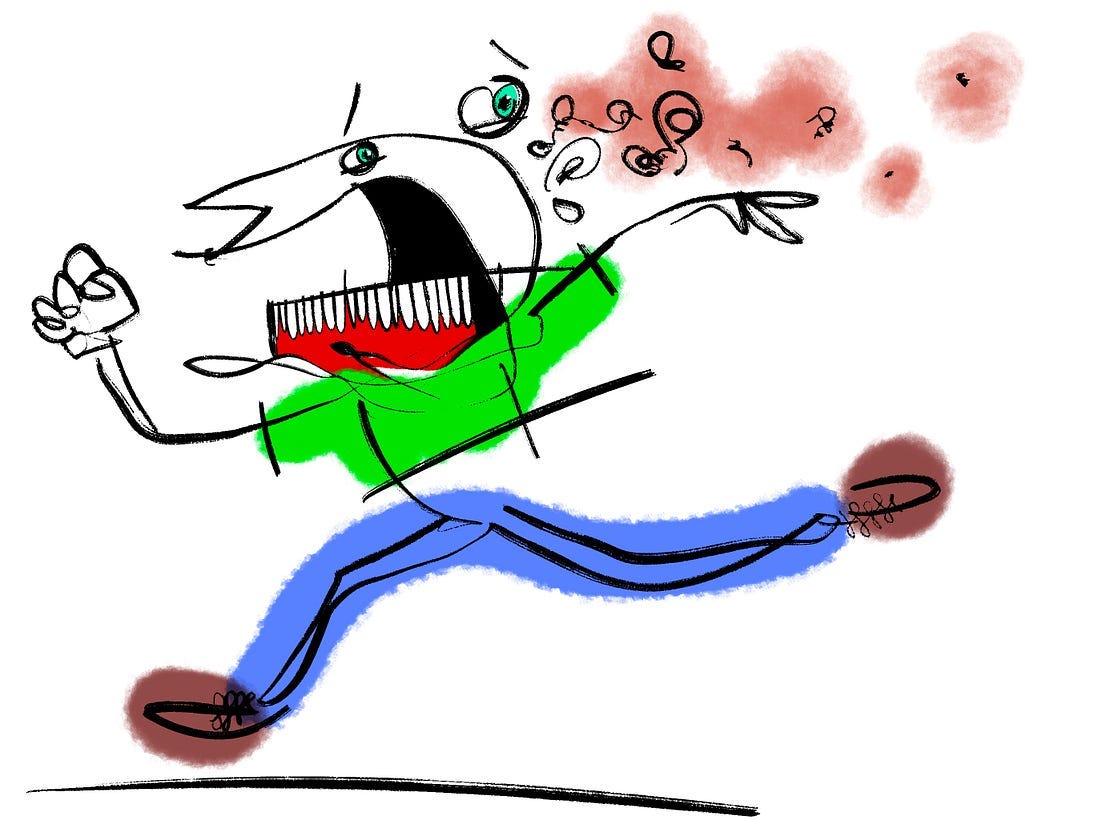
It wasn’t cold, he said, which is strange. Or maybe it’s just that he wasn’t cold. That’s strange, too. Bottom line, there was some kind of strangeness that night, because not long after he started running, he discovered something wonderful: He wasn’t getting tired. He could run and keep running. He tried running a little faster. He could, no problem. He didn’t want to stop and didn’t have to. His mind and body started talking, passing awe back and forth: We’re running and we’re still running! Have you had enough? I haven’t. By God, I never will!
Dad said, “I felt like I could run forever.”
I’ve always loved Dad’s story, but in the corn, I lived it.
I did run forever.
That, and faster than ever before.
I’ve heard when you drive out west, the wide-open spaces are so wide you don’t know how fast you’re going. You casually eye your speedometer and see you’re driving one hundred and twenty-five miles an hour when you almost just got out of the car to walk alongside and stretch your legs.
Reverse that effect. I mean, put corn so close on either side, a gauntlet of corn high-fiving you from head to toe with its flippers, and you feel like you’re running 125 mph, which is technically the speed sought by all children when they run.
Wind and cornstalks were loud in my ears. A waterfall’s thunder. Green all around me. Add to that the lovely feeling of finding order where your gut says there should only be Nature’s chaos: among growing things.
Corn is a growing thing in the extreme; they say you can actually hear corn growing, the creak of the stalks stretching their necks, which, compared to the growth speed of trees, is like the ground exploding with green fireworks.
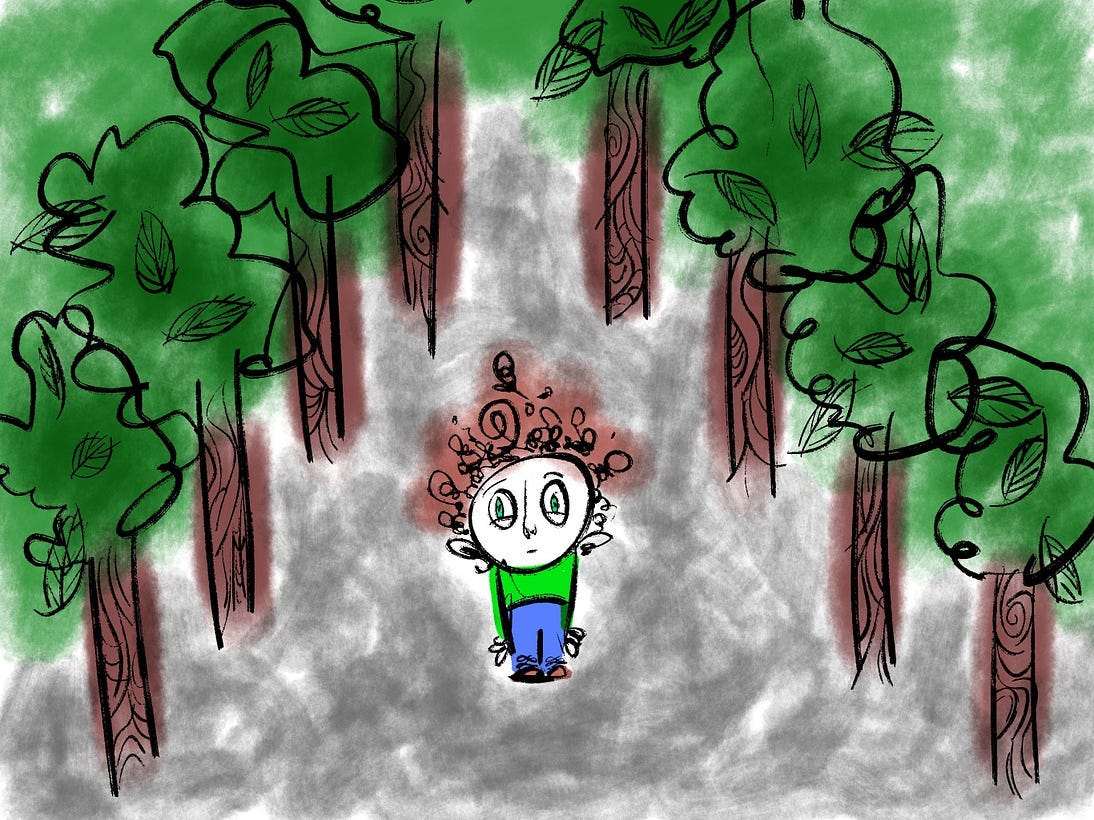
The bizarre order in the field was like an order I’d seen before in the woods. Occasionally, I’d stumbled into places where someone had planted trees in rows. It’s eerie. Lovely. You’re outside and inside at once. Pillars of a temple, and your feet on the pine needle hush are as silent as snowfall.
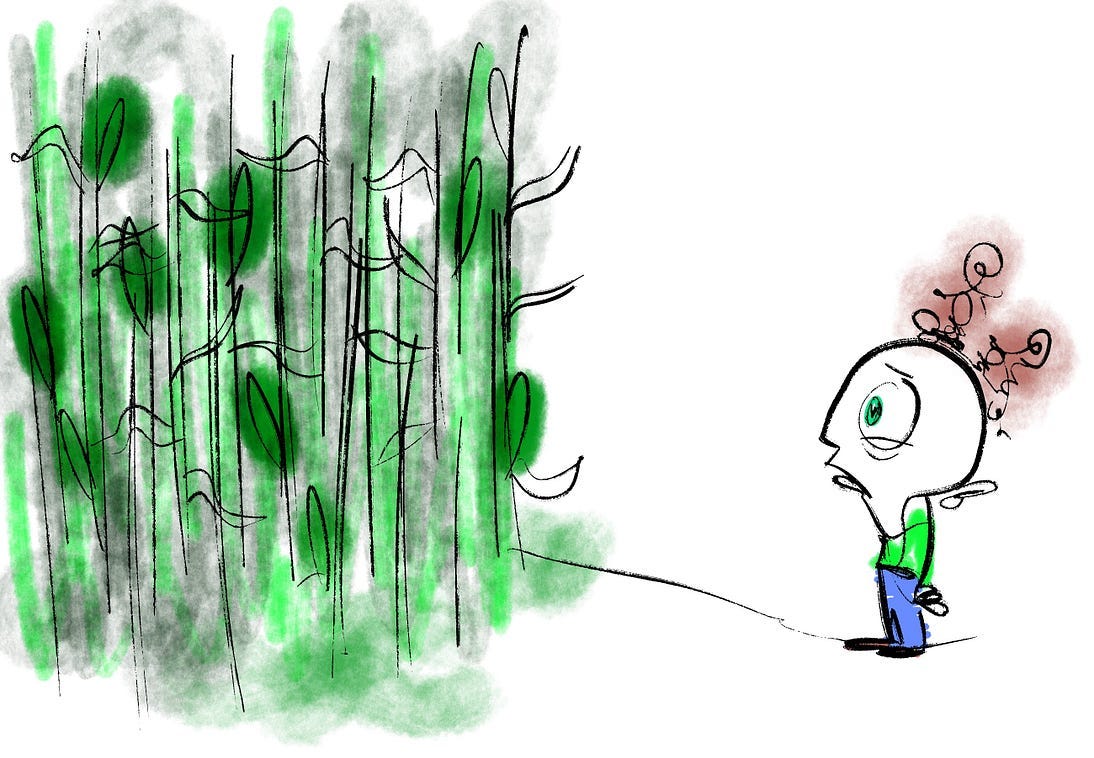
by author
We ran, we hid, we hunted each other.
We selected this hallway then that and loved them all.
We raced and raged from one end to the other and back again, feeling like little gods when we ran crossways, bursting through wall after wall, one dimension into another.
Unstoppable.
Mary
Sorry, I still can’t remember what we talked about.
It might not happen.
But there’s her little face again, and huge hair, and that boldness. By the way she acted, just stepping right up to the big-kid show and talking, she must have thought I was unlike the usual big-kid. I was safe.
My brother’s friend is my friend.
Then she was gone.
Six and gone anyway.
Word went around fast. It was a small town.
And I heard a surprising noise one day in the hall just outside the classroom. I looked and saw Jay’s mother. She was hugging the librarian, which I didn’t know was possible. Librarians get wrathful when you touch them with something even as soft as sound. If you hugged one, they’d explode as fast as a pin pricked balloon.
They would pop. You would die.
But I was seeing it. Not understanding but seeing it just the same, learning for the hundredth time (as kids do) that you don’t need to understand a thing to see it. The eyes deliver the information. You ask for context, explanations. They shrug.
“We’re just the messengers.”
The librarian had lost a child. I found that out later. A son. I don’t know how she lost him, but I’m guessing that losing him is why she was the one Mary’s mother went to with her grief.
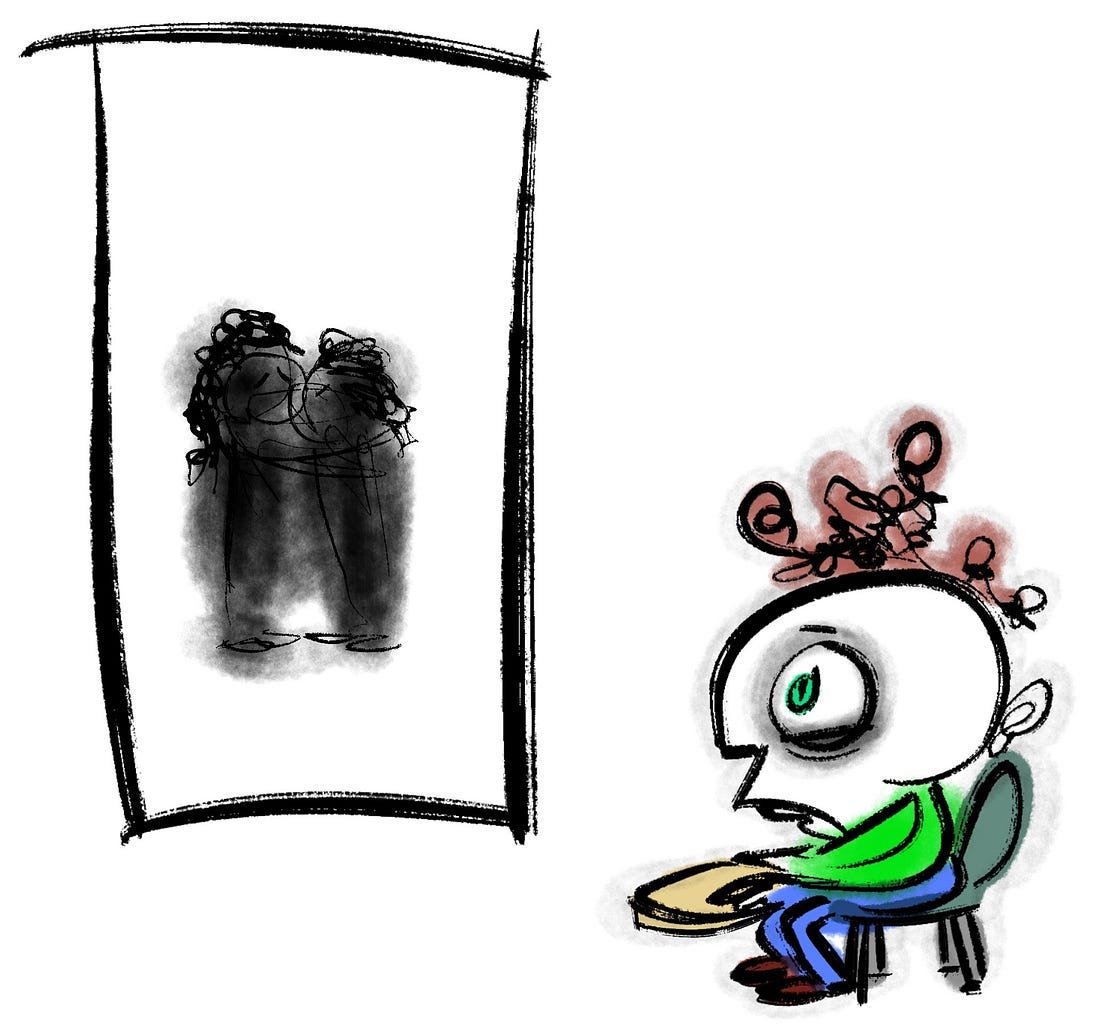
They hugged in the hallway and cried. They wept. I think the right word is “sobbed.” It was the first time I’d ever seen this kind of crying.
I’d seen and heard plenty of crying from babies and the like. Lots of crying kids. I’d cried enough myself to know the thing inside and out. But sobbing is different. I think of crying as something you control. You’re crying, but you wanted to. While doing so, you’re saying yes and thank you for the release, the relief.
But with sobbing, there’s no control. Agony pours from you, a kind of inside-out drowning. It isn’t a gentle thing. It’s water through rock, it breaks through.
by author
I watched and listened. Anyone in the vicinity of the door watched. Everyone heard. And everyone who wasn’t a narcissist or moron knew what it was about. All those intelligent heads slowly turned toward the other most dynamic thing in the world:
Jay.
My friend.
He was in the classroom with us. Seeing and hearing, too.
His mother in the hallway.
And that sound.
Jay’s silence was just as shocking to the system. Where his mother was a storm, he was a black hole.
Why did he go to school in those days? I don’t know. Maybe because he wanted to. Or had to be there for the parents’ sake, or his own. Maybe they all had to keep moving at the speed of normal life. It was either that or fall into the horror of all the places Mary was supposed to be, but wasn’t.
In the days after the crying day, I watched my friend carefully, looking for signs of the thing inside him. How could there not be signs? You get a bad night’s sleep and there are signs. You get a papercut, same thing.
You lose your sister.
I don’t know what I expected. Constant crying? Maybe some in-school tantrums. Fighting, possibly. People get angry in grief and do strange things. Maybe they get up and walk out of the classroom no matter what the teacher says to stop them. They make a show of it. Was I watching for a show? Was there any ounce of entertainment value in this thing for me? I hope not, but I am a person. I come with the usual awfulness, more than enough.
I watched him and wondered. I said hello, trying to make it sound normal. I was amazed by how normal he sounded. And by the way he hung up his jacket, the same as before, the way he put his lunchbox on the shelf, the way his face looked like it always did — easy, hopeful, the face of a kid going through the same old things.
While carrying inside…
A sister.
Mary.
What happened to her.
All of it fitting neatly inside Nine with no traces on the surface. I guess I was trying to find my friend, the one I’d seen and heard become a wild man out in the cornfield.
I understood that reaction. Perfectly. I’d been wild, too.
But this new thing?
I’d never been that. I didn’t know a person could lose so much and show nothing.
It’s possible Jay and I could have gone back to the cornfield days after Mary, maybe even on the day itself, and he would have run just as fast and war whooped just as loud as before.
I would have run, too, the forever run, even faster than my father. Because on Dad’s run, he’d been alone. In the field, I would have been chased by something that scared me terribly.
The scariest thing in the world is losing as much as the Philbrick family did.
The scariest thing is how much a person, even a child, can hold inside while giving you no sign of it.
And not die.
by author
Beautiful.